Aztec Mythology: The Universe Sustained by Blood and Motion
A Mythology of Cosmic Urgency
Of all the great mythological systems of the ancient world, few communicate a sense of existential urgency as immediate and as overwhelming as that of the Aztecs. This is a mythology in which the sun does not rise automatically, it must be fought for, sacrificed for, won again each day against the forces of darkness and dissolution. The cosmos is not a stable backdrop against which human life unfolds; it is a fragile, perpetually threatened achievement that requires constant human participation to sustain. The Aztec universe is less a gift than a contract, and the terms of that contract are written in blood.
The Aztecs, who called themselves the Mexica, were a Nahuatl-speaking people who rose to dominance in central Mexico during the fourteenth and fifteenth centuries, establishing the great city of Tenochtitlan on an island in Lake Texcoco and building an empire that, at its height, encompassed much of Mesoamerica. Their mythology was not created in isolation; it was the product of centuries of cultural synthesis, drawing on the traditions of the Toltecs, the Teotihuacanos, the Olmecs, and other Mesoamerican civilizations whose stories and deities the Mexica absorbed, reinterpreted, and made their own. What emerged from this synthesis was a mythological system of extraordinary complexity and internal coherence, one in which cosmology, ritual, political ideology, and daily life were woven together into a single seamless fabric.
Our knowledge of Aztec mythology comes primarily from post-conquest sources: the great illustrated manuscripts called codices, the ethnographic work of Franciscan friar Bernardino de Sahagún whose Florentine Codex preserved an enormous body of Nahuatl language and tradition, and the accounts of indigenous scholars and informants who worked with Spanish missionaries in the decades following the conquest of 1521. These sources are invaluable and irreplaceable, and they are also fragmentary, filtered through the perspectives of conquerors and converts, almost certainly missing dimensions of the original tradition that were deliberately suppressed or simply never recorded. What survives is nevertheless enough to reveal one of the most philosophically serious and visually overwhelming mythological traditions in human history.
The Five Suns: Creation as Catastrophe
The foundational myth of Aztec cosmology is the story of the Five Suns, the doctrine that the universe has been created and destroyed four times before the present age, and that we live in the fifth and final creation, which is itself destined for eventual annihilation. Each of the previous suns was ruled by a different deity and populated by a different race of beings, and each was destroyed by a different catastrophe corresponding to the nature of its presiding god.
The First Sun, Nahui Ocelotl (Four Jaguar), was the age of Tezcatlipoca, the Black Sun, the god of the night sky and sorcery. It was a world populated by giants who ate acorns, and it ended when Quetzalcóatl knocked Tezcatlipoca from the sky and the darkness unleashed jaguars who devoured all living things. The Second Sun, Nahui Ehécatl (Four Wind), presided over by Quetzalcóatl, ended when Tezcatlipoca took his revenge and hurricanes of wind destroyed the world, turning its people into monkeys. The Third Sun, Nahui Quiahuitl (Four Rain), was destroyed by a rain of fire, volcanic, apocalyptic, that turned its inhabitants into birds. The Fourth Sun, Nahui Atl (Four Water), ended in a great flood, its people transformed into fish.
The Fifth Sun, our own age, Nahui Ollin (Four Movement), was born at Teotihuacan, the great city that the Aztecs regarded as a place of mythological origin even though it had been abandoned for centuries before their rise. The story of its creation is one of the most dramatic and philosophically loaded narratives in all of Aztec mythology. The gods gathered in darkness after the fourth destruction and deliberated: who would sacrifice themselves to become the new sun? Two volunteers came forward. The first was Tecuciztécatl, proud, wealthy, beautiful, offering precious feathers and coral as his sacrifice. The second was Nanahuatzin, humble, poor, covered in sores, offering only dried reeds, hay, thorns stained with his own blood.
Four times Tecuciztécatl ran toward the sacrificial fire and four times he recoiled from its heat. Nanahuatzin ran forward and leapt in without hesitation, and became the sun. Shamed, Tecuciztécatl leapt in after him and became the moon. But both hung motionless in the sky. The newly created sun would not move. And the gods understood that the sun's movement, the foundation of all life and time, required the sacrifice of all of them. One by one, Ehecatl, the wind god, killed the other deities, and their deaths set the sun in motion. The universe began to run on the fuel of divine sacrifice, and that sacrifice established the template that human beings would be obligated to continue.
The doctrine of the Five Suns communicates several things simultaneously about the Aztec understanding of existence. Time is not infinite and reliably continuing, it is a series of creations, each more precarious than the last. The present world is precious precisely because it is the last, and because it was bought at the cost of everything. And the cosmic order is not self-sustaining; it requires continuous renewal through sacrifice, which is not violence for its own sake but the ritual re-enactment of the original creative act.
The Great Gods: Rivalries That Shape the Cosmos
Aztec mythology is populated by an enormous and complex pantheon, scholars have identified hundreds of named deities, but several figures stand at the center of the cosmological drama with particular force and clarity.
Huitzilopochtli, the Hummingbird of the South, the god of the sun and of war, was the patron deity of the Mexica themselves, the divine champion who had led them on their long migration from the mythical homeland of Aztlán to the site of Tenochtitlan. His birth myth is one of the most dramatic in the tradition. His mother, Coatlicue, the Earth Goddess, She of the Serpent Skirt, became pregnant after a ball of feathers descended on her while she was sweeping at the sacred hill of Coatepec. Her daughter Coyolxauhqui and her four hundred sons, the Centzonhuitznahua (the stars of the south), were outraged by what they saw as their mother's disgrace and marched to kill her. Huitzilopochtli was born fully armed at the moment of attack, immediately slew Coyolxauhqui, dismembered her body, and hurled her head into the sky where it became the moon.
This myth encodes the central cosmological drama of Aztec religious life. Every day the sun, Huitzilopochtli, must defeat the moon and stars in order to rise. Every dawn is a victory won in battle. And the great temple of Tenochtitlan, the Templo Mayor, was understood as the hill of Coatepec itself, the site of that primordial battle perpetually re-enacted. At the base of the temple's stairway, a great circular stone carved with the dismembered body of Coyolxauhqui was discovered by archaeologists in 1978, a visual re-statement of the mythological event that literally grounded the entire political and religious architecture of the Aztec empire.
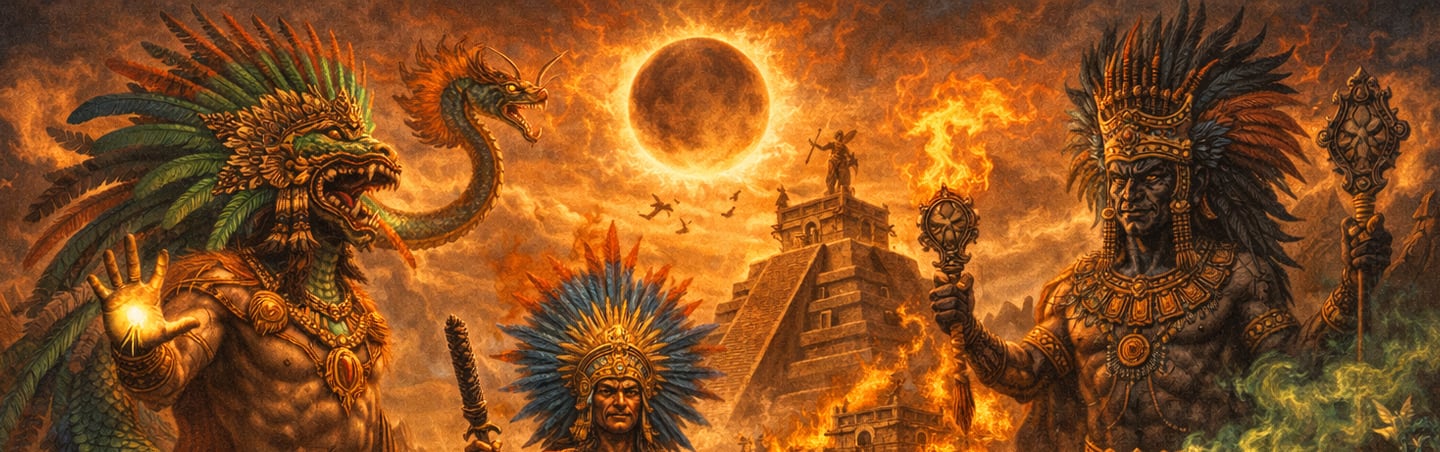
Quetzalcóatl, the Feathered Serpent, one of the most ancient and widely distributed figures in all of Mesoamerican religion, occupied an extraordinarily complex position in Aztec mythology. He was simultaneously a creator god, a wind god, a god of learning and the priesthood, the mythological founder of civilization, and a historical figure: the legendary priest-king of the Toltecs who had ruled at Tula, been driven out by the sorcery of Tezcatlipoca, and departed eastward over the sea on a raft of serpents, promising to return. This last element, the prophecy of return, would acquire catastrophic historical resonance when Hernán Cortés arrived from the east in 1519, though the degree to which the Aztecs actually interpreted Cortés as the returning Quetzalcóatl is considerably debated by modern scholars.
Within the mythology proper, Quetzalcóatl is associated with the creative, civilizing principle, with the arts, with agriculture, with the calendar, with the creation of human beings themselves. In one important myth, he descends to the underworld Mictlan to retrieve the bones of the dead from the previous creation, is tricked by Mictlantecuhtli the lord of the dead, drops and breaks the bones, and must grind the fragments and mix them with his own blood to create the current race of humanity. We are, in this understanding, literally made of broken, imperfect material, reconstituted by divine sacrifice and animated by divine blood. Human imperfection is not a fall from grace but a structural feature built into the creation.
Tezcatlipoca, Smoking Mirror, whose obsidian mirror revealed all things including the hidden contents of human hearts, was in many respects Quetzalcóatl's eternal adversary, the principle of darkness, conflict, and change set against Quetzalcóatl's creative order. But Tezcatlipoca was not simply evil. He was the force of necessity, the god who understood that the world could not be sustained by creation alone, that destruction and transformation were as essential to the cosmic order as building and preserving. He was the patron of warriors, of sorcerers, of those who operated in the dark spaces of human experience where simple moral categories did not apply. His calendar sign was One Death, and he moved through the mythology as a reminder that nothing achieved by the creative principle is permanent.
Tlaloc, Coatlicue, and the Deities of Earth and Rain
Not all Aztec mythology operates at the scale of cosmic creation and solar warfare. Some of the tradition's most powerful figures are more intimate in their concerns, governing the immediate cycles of rain, fertility, death, and renewal on which agricultural life depends.
Tlaloc, the Rain God, one of the most ancient deities in the Mesoamerican tradition, his goggle-eyed face appearing in the art of Teotihuacan centuries before the Aztecs, was both essential and terrible. He sent the rains that made the maize grow, and he also sent lightning, hail, drowning, and the diseases of water. His paradise, Tlalocan, was a place of eternal spring and abundance where those who died by drowning or lightning went, a more pleasant afterlife than most Aztecs could expect, reserved for those marked by the Rain God's particular attention. The children sacrificed to Tlaloc, one of the most disturbing aspects of Aztec ritual from a modern perspective, were understood as messengers sent to solicit his blessing, their tears as they were carried to the sacrifice believed to prefigure and encourage the rains.
Coatlicue, the Earth Mother, presents one of the most visually overwhelming figures in all of Mesoamerican art. The great statue of her discovered in 1790 and now in Mexico City's National Museum of Anthropology depicts her as a massive, terrifying figure: a skirt of writhing serpents, a necklace of human hands and hearts and a skull pendant, her head replaced by two serpent heads facing each other, the blood jets from her severed neck transformed into serpentine life-force. She is simultaneously the earth that sustains all life and the earth that devours all the dead. She gives birth and she consumes. Her monstrousness is not a failure of imagination but a precise theological statement: the force that feeds us and the force that destroys us are the same force.
The Underworld, the Calendar, and the Shape of Fate
Aztec eschatology, the mythology of death and afterlife, was more complex and less morally structured than most Western traditions. Where one went after death was determined not primarily by how one had lived but by how one had died. Warriors killed in battle and women who died in childbirth, both understood as forms of sacrifice, became companions of the sun, accompanying it on its daily journey across the sky before being transformed into hummingbirds and butterflies. Those who drowned or died from rain-related diseases went to the paradise of Tlalocan. The vast majority of the dead went to Mictlan, the nine-level underworld, undertaking a four-year journey through its dangers before finally reaching rest in the deepest level.
The Aztec calendar system, itself a mythological achievement of the first order, consisted of two interlocking cycles: the 365-day solar calendar xiuhpohualli and the 260-day ritual calendar tonalpohualli, whose combination produced a 52-year cycle at the end of which the world was understood to be at particular risk of destruction. The New Fire Ceremony, held at the end of each 52-year cycle, was one of the most dramatic ritual expressions of the Aztec cosmological worldview: all fires were extinguished across the empire, people waited in darkness and fear on hilltops and rooftops, and priests at the Hill of the Star waited to see whether the Pleiades would continue their movement across the sky, evidence that the world would continue for another 52 years. When the sign came, a new fire was drilled on the chest of a sacrificial victim and carried by runners to relight fires across the land. The relief of that moment, the world continuing, the fire burning again, was the ritual expression of the mythology's most fundamental conviction: that existence is not guaranteed, and that its continuation is cause for genuine and overwhelming gratitude.
The Weight of the Mythology
Aztec mythology asks something of its adherents that few mythological traditions have demanded so explicitly: the acknowledgment that the universe is a sacrifice, that human life exists only because divine beings died to create it, and that the appropriate response to that gift is not simply gratitude but active, costly participation in the work of sustaining the cosmos. This is a mythology that takes seriously the moral weight of existence itself, the debt incurred simply by being alive in a world that was purchased at such enormous price.
It is also a mythology of extraordinary aesthetic power, expressed in some of the most remarkable art, architecture, and poetry that human civilization has produced. The great temples of Tenochtitlan, the painted codices, the sacred songs and philosophical dialogues recorded by Sahagún's informants, all of these testify to a civilization that thought with complete seriousness about the deepest questions of existence and built its entire social and political life around the answers its mythology provided.
To encounter Aztec mythology seriously is to be challenged in the most fundamental way: to ask what we owe to the world that sustains us, and what we are willing to give in return.
480-366-3550 (Domain Sales)
© SDBEST LLC, 2025. All rights reserved.
Sponsorship Disclosure
Terms of Service