
Buddhist Mythology: The Stories That Illuminate the Path
A Mythology Born from Awakening
Buddhist mythology occupies a unique position among the great mythological traditions of the world. It is, at its origin, the mythological elaboration of a historical event, or what the tradition presents as a historical event: the awakening of Siddhartha Gautama beneath a pipal tree in northeastern India sometime in the fifth or fourth century BCE. Unlike the Greek or Norse or Chinese traditions, which grew organically from prehistoric religious imagination and were never anchored to a single founding moment, Buddhist mythology radiates outward from this central event, the Buddha's enlightenment, like light from a lamp, illuminating in every direction the nature of existence, the structure of the cosmos, the possibilities open to conscious beings, and the path that leads from suffering to liberation.
And yet to call Buddhist mythology simply the elaboration of a historical religion is to underestimate both its antiquity and its extraordinary imaginative range. Buddhism absorbed, transformed, and generated mythological material on a scale that rivals any tradition in human history. As it spread from India across Central Asia, China, Japan, Korea, Tibet, Southeast Asia, and eventually the entire world, it encountered and incorporated local deities, cosmological systems, narrative traditions, and ritual practices, producing an almost bewildering diversity of Buddhist mythological expression. The serene forest philosophy of the earliest Pali texts exists in the same broad tradition as the elaborate celestial cosmology of the Mahayana sutras, the fierce tantric deities of Vajrayana Buddhism, the gentle paradise mythology of Pure Land devotion, and the iconographically overwhelming art of Tibetan thangka painting. To speak of Buddhist mythology is therefore to speak of a continent rather than a country, vast, internally diverse, and never fully mappable from any single vantage point.
The Life of the Buddha as Mythological Template
The biography of Siddhartha Gautama, as it was elaborated over centuries into the Buddhacarita, the Lalitavistara, and dozens of other texts, is itself a mythological narrative of the highest order, structured by archetypal patterns that recur across world mythology while expressing something entirely distinctive about the Buddhist understanding of human potential and cosmic reality.
The birth of the future Buddha was attended by cosmic signs that established his nature before he drew his first breath. His mother Maya dreamed that a white elephant carrying a white lotus descended from the heavens and entered her side, a dream interpreted by court brahmins as signifying the birth of either a great world-ruler or a great spiritual teacher. When the child was born, he emerged from his mother's side, already pure, already aware, and took seven steps in each of the four directions, declaring with each step his intention to achieve liberation for the sake of all beings. Flowers rained from heaven. The earth trembled. The gods rejoiced.
These mythological embellishments around the Buddha's birth are not mere decorative piety. They serve to establish, from the very beginning, that what is happening in this story is not simply the life of an extraordinary individual but a cosmic event, a moment when the deepest possibilities of conscious existence are brought to expression, when the universe itself acknowledges what is unfolding. The white elephant, the lotus, the seven steps, the declarations, all of these encode the tradition's conviction that Buddhahood is not an accident but a fulfillment, the culmination of countless previous lifetimes of spiritual preparation narrated in the Jataka tales.
The encounter with suffering, the Four Sights that shattered the young prince's sheltered existence, constitutes one of the most psychologically powerful mythological narratives in the tradition. Venturing outside the palace walls despite his father's efforts to shield him from all unpleasantness, Siddhartha encountered in succession an old man, a sick man, a corpse, and a wandering ascetic. The first three revealed the inescapable facts of the human condition; the fourth suggested the possibility of a path through them. This quadruple encounter is not simply biographical anecdote; it is the mythology's essential statement about the beginning of the spiritual path, the moment when the comfortable illusions that sustain ordinary life are stripped away and the seeker is confronted, naked, with the truth of impermanence. Every human being who begins a genuine spiritual search enacts, in some form, the myth of the Four Sights.
The night of the Buddha's enlightenment at Bodh Gaya is the central mythological event of the entire tradition, and the accounts given of it in various texts are among the most dramatic and cosmologically significant narratives in world religious literature. Seated beneath the Bodhi Tree, the future Buddha was attacked by Mara, the Lord of Illusion, Death, and Desire, the mythological embodiment of everything that binds conscious beings to the cycle of suffering. Mara sent his armies, desire, aversion, hunger, thirst, fear, doubt, hypocrisy, against the meditating prince, and when these failed he sent his daughters to seduce him. All of these assaults were met with absolute stillness, rooted in the earth itself: the future Buddha touched the ground with his right hand, calling the earth as witness to his countless lifetimes of virtue and spiritual preparation, and Mara's armies dissolved.
This gesture, bhumisparsha mudra, the earth-touching gesture, became one of the most reproduced images in all of Buddhist art, the moment of supreme unshakeability, of the ground of being confirming the ground of awakening. It is also a mythological statement of extraordinary depth: the Buddha's awakening is not achieved by transcending the earth but by being rooted in it, by calling on the accumulated reality of lived experience rather than on any external divine authority.
The Cosmological Universe: Multiple Worlds and Countless Buddhas
Early Buddhism, as preserved in the Pali Canon, was relatively restrained in its cosmological elaboration, focused on the structure of the mind and the path of liberation rather than the geography of the universe. But as Buddhism developed into the Mahayana tradition, the Great Vehicle, its cosmological imagination expanded to a scale that is genuinely staggering, producing one of the most elaborate and philosophically interesting cosmic maps in any religious tradition.
The Mahayana universe consists of innumerable world systems, trichiliocosms, each containing its own earth, heavens, and hells, each presided over by its own Buddha. The number of these world systems is compared in the sutras to the grains of sand in the Ganges River, and then to the grains of sand in a number of Ganges Rivers equal to the grains of sand in the original river, a recursive gesture toward a quantity that defeats all ordinary comprehension. In this universe, Shakyamuni, the historical Buddha, our Buddha, is not the only Buddha but one among countless Buddhas who have awakened, are awakening, and will awaken across the infinite reaches of space and time.
This cosmological expansion has profound mythological implications. It means that the universe is not neutral with respect to awakening, it is, in a deep sense, oriented toward it, populated by countless beings who have made the journey from suffering to liberation and who remain, in various forms, available to help other beings make the same journey. The universe is not indifferent; it is compassionate, structured by the accumulated liberating power of all the Buddhas who have ever awakened within it.
The vertical cosmology of the Buddhist universe, its layered heavens and hells, was elaborated in considerable detail across both Theravada and Mahayana texts. Above the human realm extend numerous heavenly worlds inhabited by gods, celestial musicians, and beings of increasing subtlety and luminosity, the desire realm, the form realm, the formless realm, each more refined and more temporally extended than the last. Below the human realm extend the various hell realms, not eternal punishments in the Abrahamic sense but states of intense suffering that, however prolonged, are ultimately impermanent, lasting only as long as the karma that generated them. Between and around these realms move beings in states of greed, anger, and confusion whose mythological forms, hungry ghosts with enormous bellies and tiny mouths, animals trapped in reactive instinct, express the Buddhist understanding of the psychological states that bind conscious beings to the cycle of samsara.
Bodhisattvas: The Mythology of Compassion
The most distinctive and mythologically rich contribution of Mahayana Buddhism is the elaboration of the bodhisattva, the being who, having developed the capacity for enlightenment, chooses to delay their own final liberation until all other conscious beings have been led to freedom. The bodhisattva ideal transforms Buddhist mythology from a tradition focused primarily on individual liberation into a cosmic drama of universal compassion, a drama in which the entire universe is understood as a field of liberating activity, populated by beings who have made the extraordinary vow to remain in the cycle of existence for as long as there are beings who suffer.
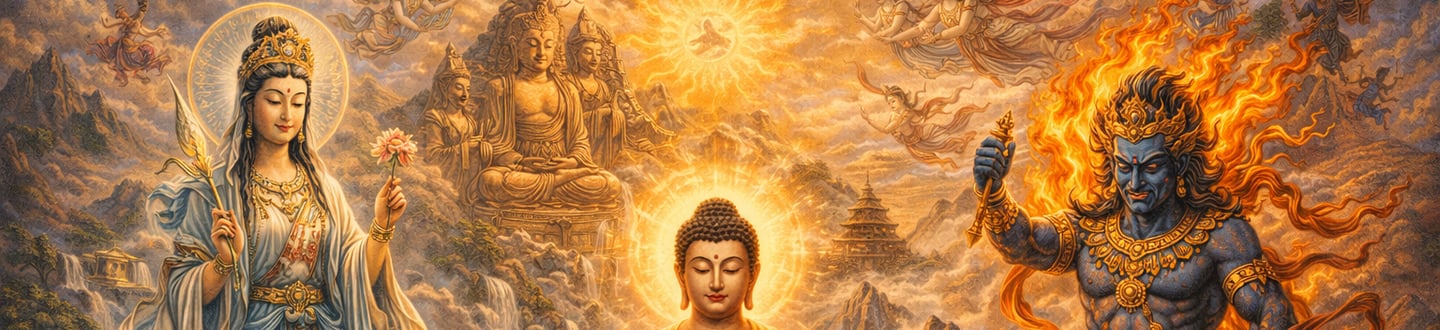
Avalokiteshvara, the Bodhisattva of Compassion, known as Guanyin in China and Kannon in Japan, is perhaps the most universally beloved figure in all of Buddhist mythology, and one of the most widely worshipped religious figures in the world. His or her name means "the one who hears the cries of the world," and the mythology elaborated around this figure is of extraordinary tenderness. Avalokiteshvara is said to appear in whatever form is most helpful to the being who needs assistance, as a monk, a woman, a child, a god, an animal, moving through all the realms of existence in response to the sound of suffering. In the famous myth of the Thousand-Armed Avalokiteshvara, the bodhisattva's head split into eleven faces and his body sprouted a thousand arms when he contemplated the vastness of suffering in the universe and the inadequacy of two arms to address it all, each palm bearing an eye that sees the need of every being, each hand holding an instrument of liberation suited to a different kind of suffering.
Significantly, as Buddhism spread to East Asia, Avalokiteshvara underwent a gradual transformation from a male to a female figure, Guanyin, the Goddess of Mercy, who became the most widely venerated religious figure in Chinese history, her white-robed image presiding over homes, temples, and public spaces across China, Japan, Korea, and Vietnam. This transformation was not a corruption of the original mythology but its flowering, the tradition's recognition that compassion, in its fullness, transcends the gendered categories through which human beings ordinarily understand the world.
Manjushri, the Bodhisattva of Wisdom, wields a flaming sword that cuts through ignorance and a text of the Perfection of Wisdom that contains the liberating insight into the nature of reality. His mythology celebrates the intellectual dimension of the Buddhist path, the understanding that liberation is not merely an emotional or moral achievement but a cognitive one, requiring the direct perception of how things actually are rather than how ignorance and desire cause us to perceive them.
Maitreya, the Future Buddha, the Buddha who is to come, occupies a position in Buddhist mythology analogous in some respects to the messianic figure in other traditions. Maitreya is currently understood to be dwelling in the Tushita Heaven, awaiting the appropriate moment to descend to earth and teach the Dharma again when the teachings of Shakyamuni have been forgotten and the world has fallen sufficiently into suffering to be receptive to a new teacher. His mythology carries a distinctive quality of patient expectation, the world moving through its cycles of forgetting and remembering, and the great teacher waiting with infinite patience for the moment of greatest need.
Tibetan Buddhist Mythology: The Fierce and the Luminous
Tibetan Buddhism, Vajrayana, the Diamond Vehicle, developed one of the most visually overwhelming and philosophically complex mythological systems in human history, synthesizing Indian Buddhist tantra with the indigenous Bon religion of Tibet and expressing itself in an iconography of extraordinary power and density. The mythology of Vajrayana uses fierce, sexual, and apparently terrifying imagery not as a departure from the Buddhist path but as a direct expression of its deepest teachings, the recognition that the energies ordinarily associated with aggression, desire, and fear are not obstacles to awakening but, when properly understood and transformed, its very fuel.
The wrathful deities of Tibetan Buddhist mythology, the Dharmapalas or Dharma Protectors, the Herukas, the terrifying forms of the meditational deities, appear with blazing eyes, fanged mouths, skulls and severed heads as ornaments, trampling figures representing ignorance and ego beneath their feet. These are not evil beings but enlightened presences whose ferocity is the compassionate wrathfulness of awakening, the force that cuts through the most deeply rooted patterns of confusion and clinging, that cannot be gentle because gentleness is insufficient to address the depth of the problem.
The Bardo Thödol, the Tibetan Book of the Dead, presents perhaps the most elaborately detailed mythological account of consciousness after death in any tradition. In the period between death and rebirth, the bardo, the consciousness of the deceased encounters a sequence of visions that are understood as projections of the mind's own nature: first the brilliant clear light of the dharmakaya, the fundamental nature of reality, which most beings fail to recognize and which, if recognized, offers immediate liberation; then the peaceful deities radiating subtle colored lights alongside the duller lights of the six realms of existence; then the wrathful deities, who are the same as the peaceful deities in more intense expression. At each stage, the text, traditionally read aloud to the dying or recently dead, urges recognition: these visions are your own mind, do not be attracted to the comfortable lights of the lower realms, do not be frightened by the wrathful forms, recognize them as your own nature and be liberated.
The Bardo Thödol is a mythology of consciousness at its most naked, stripped of the ordinary supports of embodied life, confronted directly with the projections of its own deep patterns, offered at every moment the possibility of recognition and liberation. It is also, in its way, a profoundly democratic mythology: liberation is available at every moment, in every condition, to every being, because what is being recognized is not something achieved or acquired but something already present, the fundamental nature of mind itself.
Pure Land Mythology: The Western Paradise
Pure Land Buddhism, enormously influential across East Asia and particularly in China and Japan, developed a mythology of devotional aspiration centered on Amitabha Buddha (Amituofo in Chinese, Amida in Japanese) and his Western Pure Land, Sukhavati, the Land of Bliss. According to the foundational mythology preserved in the Pure Land sutras, Amitabha was a monk called Dharmakara who made forty-eight vows to create a perfect world for the liberation of all beings, a buddha-field where the conditions for awakening were maximally favorable, free from the distractions and sufferings that impede spiritual development in ordinary worlds. Having fulfilled these vows through countless lifetimes of practice, he became Amitabha Buddha and his Pure Land came into existence in the western direction, beyond immeasurable worlds.
The mythology of Sukhavati is one of the most beautiful and emotionally resonant in the Buddhist tradition. The Land of Bliss is described in the sutras in extraordinary sensory detail: jeweled trees bearing flowers and fruits of every kind, lotus ponds of four colors whose waters rise and fall to the temperature desired by each being who enters them, birds of brilliant plumage singing the teachings of impermanence and non-self and the path to liberation, a light of measureless beauty suffusing everything without casting shadows, the sound of the Dharma carried everywhere by gentle breezes. The beings who dwell there are born from lotus flowers, attended by bodhisattvas, free from suffering, and certain of achieving awakening.
The gateway to this paradise is the practice of nembutsu, the mindful recitation of Amitabha's name, Namu Amida Butsu in Japanese, Namo Amituofo in Chinese, understood in the most devotional forms of the tradition as sufficient, through the power of Amitabha's vows, to ensure rebirth in the Pure Land. This mythology democratized Buddhist liberation in ways that earlier forms of the tradition had not fully achieved: one needed no extensive meditation practice, no scholarly mastery of doctrine, no monastic ordination, only sincere faith in Amitabha's compassionate vow and the practice of calling his name. The dying peasant calling the name of Amitabha with sincere heart was guaranteed the same destination as the accomplished scholar-monk.
The Jataka Tales and the Mythology of Accumulated Virtue
One of the most beloved and extensive bodies of Buddhist mythological narrative is the Jataka collection, the stories of the Buddha's previous lives, in which he appears as prince and peasant, god and animal, king and merchant, accumulating across hundreds of incarnations the perfections of generosity, morality, renunciation, wisdom, energy, patience, truthfulness, resolution, loving-kindness, and equanimity that would eventually flower into his final awakening as Shakyamuni Buddha.
The Jataka tales range from simple animal fables to complex narratives of political philosophy and selfless sacrifice, and their variety and abundance, 547 tales in the Pali canon alone, make them one of the richest bodies of narrative literature in the world. The tale of Prince Vessantara, the culminating Jataka in the Theravada tradition, presents the most extreme possible expression of the perfection of generosity: a prince who gives away everything, including his white elephant, his children, and finally his wife, in an act of total relinquishment whose spiritual logic is that genuine liberation requires the complete release of all clinging, even the most natural and beloved forms of attachment. The tale is disturbing in ways that Buddhist commentators acknowledge: it asks its readers to hold simultaneously the absolute value of compassionate detachment and the concrete human suffering that the prince's gifts occasion. It does not resolve this tension but insists that it be felt in its full weight.
The Dharma as Mythology's Destination
Buddhist mythology is unique among the great mythological traditions in its explicit orientation toward its own transcendence. The myths, the cosmologies, the celestial Buddhas and fierce protectors and jeweled paradises, all of these are, in the Buddhist understanding, upaya, skillful means: pedagogical tools whose purpose is to point beyond themselves toward a reality that no myth can fully contain. The famous raft metaphor of the Pali Canon is the mythology's most honest self-assessment: the teachings are a raft for crossing the river of suffering, not an object to be carried on one's head once the crossing is complete. The mythology serves the awakening, and awakening is the point at which mythology, having done its work, is finally, gratefully, released.
This does not diminish the mythology; it gives it a depth and a freedom that few other traditions achieve. Because Buddhist mythology does not claim to be literally true in the way that the cosmological myths of other traditions sometimes do, it is free to be as lavish, as paradoxical, as imaginatively overwhelming as the task of pointing toward liberation requires. The thousand arms of Avalokiteshvara, the immeasurable light of Amitabha, the diamond clarity of Manjushri's wisdom sword, the terrifying compassion of the wrathful deities, the patient serenity of the future Buddha waiting in his heavenly palace, all of these are fingers pointing at the moon. Buddhist mythology, at its best, never mistakes the finger for what it points toward. And in that discipline of self-aware pointing, it achieves something that may be its greatest gift to the human imagination: the demonstration that the most profound truths require the most expansive stories, and that the stories, rightly told, have the power to dissolve the suffering they describe.
480-366-3550 (Domain Sales)
© SDBEST LLC, 2025. All rights reserved.
Sponsorship Disclosure
Terms of Service