Greek Mythology: The Stories at the Root of the Western World
A Mythology Born from Wonder and Dread
Greek mythology is not a single, unified system. It is more like a vast, living conversation, a chorus of voices speaking across centuries, regions, and literary traditions, all circling the same fundamental questions: Why does the world exist? What do the gods want from us? What does it mean to be human in a cosmos that is simultaneously beautiful and indifferent? The myths that have come down to us through Homer, Hesiod, the tragic playwrights, and countless other sources represent only a fraction of a much larger oral and cultural inheritance, and yet even that fraction is staggering in its richness, its psychological depth, and its enduring power over the Western imagination.
What distinguishes Greek mythology from many other ancient mythological traditions is the degree to which the gods are human, not metaphors for natural forces alone, but personalities, with desires and grudges, with vanities and moments of surprising tenderness. The Greek gods are not perfectly good. They are not even reliably just. They are powerful in ways that make human power look pathetic, and they are petty in ways that make human pettiness look forgivable. This gave Greek mythology an extraordinary dramatic tension: the universe is ruled by beings who feel exactly as we do, but who face no consequences. What, then, is a human being to do?
In the Beginning: Chaos, Cosmos, and the Titans
The Greek mythological account of creation, as Hesiod recorded it in his Theogony around the eighth century BCE, begins not with a god but with a condition, Chaos, the primordial void or gap, the formless expanse before distinction existed. From Chaos emerged Gaia (the Earth), Tartarus (the deep abyss beneath the earth), and Eros (the force of desire and connection). From Gaia came Ouranos (the Sky), and from their union came the first divine generation: the Titans, twelve enormous beings of primordial power, along with the Cyclopes and the hundred-handed giants.
Ouranos, fearing displacement by his children, pushed each one back into the body of Gaia as it was born. The anguish of this imprisonment drove Gaia to arm her youngest son, Kronos, with an adamantine sickle. Kronos castrated his father, the severed flesh falling into the sea, from which the foam-born Aphrodite arose, and took power over the cosmos. He then proceeded to do precisely what his father had done, swallowing each of his children by Rhea as they were born. Rhea, in grief and fury, hid her last child and gave Kronos a stone wrapped in swaddling clothes. That hidden child was Zeus.
The pattern embedded in this genealogy of violence is one of the deepest structures in Greek mythological thought: each generation of power is born from the overthrow of the previous one. Creation is not peaceful. It is contested, bloody, and driven by fear. The universe we inhabit, orderly, beautiful, presided over by the Olympians, rests on a foundation of primordial violence, and the memory of that violence is never entirely suppressed. The Titans are not destroyed; they are imprisoned in Tartarus. Chaos is not eliminated; it is organized. The threat of regression is always present.
The Olympians and the Shape of Divine Power
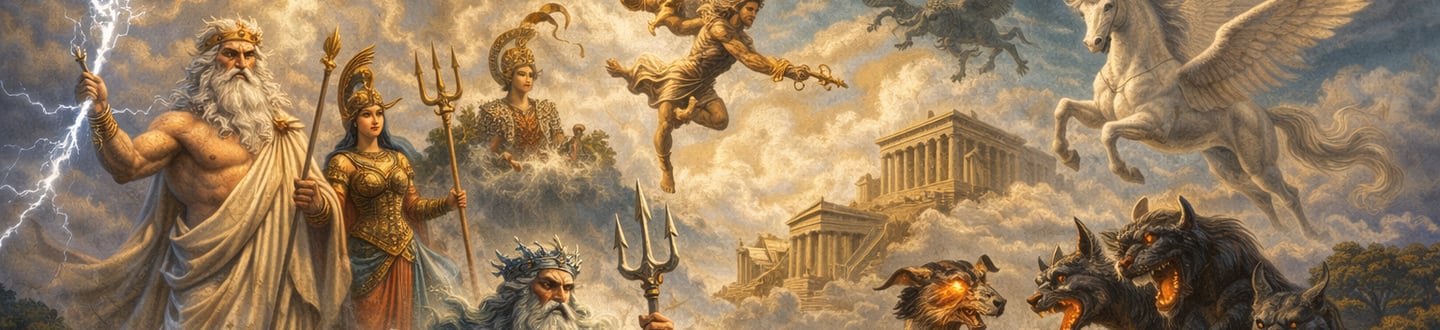
When Zeus defeated Kronos and the Titans in the great war called the Titanomachy, he established a new divine order centered on Mount Olympus. He divided sovereignty with his brothers: Poseidon received the seas, Hades the underworld, and Zeus retained dominion over the sky and became the king of the gods. But Zeus's power, though supreme, was never absolute. The other Olympians, his wife Hera, his siblings, his children, were independent personalities with their own domains, their own agendas, and their own willingness to work against him when their interests demanded it.
The twelve Olympians as a collective represent something like a complete map of human concern. Athena governed wisdom, craft, and strategic warfare. Apollo presided over light, music, poetry, prophecy, and healing, a combination that expresses the Greek intuition that clarity of mind and artistic beauty are related expressions of the same divine quality. His twin sister Artemis ruled the wilderness, the moon, and the hunt, remaining perpetually virgin, answering to no masculine authority, moving freely through forests and mountains with her company of nymphs. Ares was the brutal, blood-drunk force of war, distinct from Athena's strategic military intelligence, Greece understood that warfare has two faces, one cool and one savage. Hermes was the divine messenger, the guide of souls to the underworld, the patron of travelers, merchants, and thieves, a figure of boundaries crossed and communications made possible. Hephaestus, lame and brilliant, worked his forge beneath the earth, creating objects of impossible beauty: the armor of Achilles, the chains that bound Prometheus, the net that trapped Ares and Aphrodite in their adulterous embrace. Aphrodite herself, born from the sea-foam of Ouranos's wound, was the irresistible force of erotic love and beauty, and the Greeks understood her as genuinely dangerous, a power that undid reason and dissolved the boundaries of the self.
Dionysus, who occupies a somewhat different position in the Olympian order, was perhaps the most theologically complex of the Greek gods. The god of wine, ecstasy, theater, and dissolution, he represented everything in human experience that cannot be contained by rational order. His myths are full of madness, transformation, and violence, the Maenads who tore animals and men apart in sacred frenzy, the king Pentheus who was destroyed for refusing to honor him. Dionysus was the god of the mask, of the stage, of the moment when a person steps outside themselves and becomes something other. Greek tragedy itself was performed in his honor.
The Heroic Tradition
If the Olympian myths explore the nature of divine power, the heroic tradition explores the human condition at its most extreme, what a human being can achieve, and what it costs. Greek heroes are not simply strong or brave. They are defined by a particular quality the Greeks called arete, often translated as excellence or virtue, but meaning something more like the full and burning realization of one's highest capacities. The hero strives, suffers, and is destroyed or transformed by the very greatness of his striving. There is something almost unbearable in the Greek heroic ideal.
Heracles, the Romans called him Hercules, is the most universal of the Greek heroes, a figure whose myths were known across virtually every region of the ancient Mediterranean world. His Twelve Labors, imposed as penance for the madness Hera inflicted on him, are at one level a catalogue of monster-slaying and boundary-pushing: the Nemean Lion, the Lernaean Hydra, the Augean Stables, the Cattle of Geryon at the edge of the known world. But at a deeper level they are a myth about the hero who cannot rest, who is driven always to the outer limit of the possible, whose enormous capacity for both violence and suffering makes him both more and less than human. He was ultimately granted apotheosis, translated to Olympus and made divine, but only after immolation on a funeral pyre. Greatness, in the Greek heroic tradition, burns.
Achilles, the central figure of Homer's Iliad, presents a different and more philosophically acute version of the heroic ideal. He is the greatest warrior of his age, and he knows it, and the knowledge is not a comfort but a trap. He has been told that he can choose between a long, undistinguished life and a short life of supreme glory. He chooses glory. And then, in the poem, he must watch as the choice reveals its true cost: the death of Patroclus, the hollowness of rage, the strange tenderness of the scene where he returns Hector's body to the weeping father Priam. Homer does not celebrate Achilles' greatness without also asking what it destroys, in him and in everyone around him.
Odysseus presents yet another face of the heroic ideal, the man of cunning rather than raw strength, the survivor, the storyteller. His ten-year journey home in the Odyssey takes him through the full range of mythological danger: the Cyclops, the Sirens, Scylla and Charybdis, the enchantress Circe, the seductive goddess Calypso who offers him immortality and whom he refuses, choosing instead his mortal home and his mortal wife. The choice to remain human, to insist on the ordinary beauty of home and hearth over divine stasis, is one of the most profound statements in all of Greek mythology about the value of the human condition precisely because it is finite.
The Myths of Transformation
Among the most haunting and psychologically resonant strands of Greek mythology are the stories of transformation, men and women changed into animals, plants, celestial bodies, or natural features as the consequence of divine encounter. The Roman poet Ovid gathered these stories in his Metamorphoses, but most of them are far older, and together they express a deep Greek intuition about the relationship between the human and the natural world.
Daphne, fleeing the pursuit of Apollo, was transformed into a laurel tree by her father, the river god Peneus, at the very moment Apollo's hands closed on her. Apollo, unable to possess the woman, made the tree his sacred plant, wearing her leaves as his crown forever. The myth is disturbing in ways that the Greeks did not flinch from: divine desire is overwhelming, consent is irrelevant to the gods, and transformation is sometimes the only escape from power. Narcissus, fixated on his own reflection, wasted away and became the flower that bears his name, a myth about the self-annihilating trap of solipsism. Echo, who could only repeat the last words she heard, faded until only her voice remained. Actaeon, who accidentally glimpsed Artemis bathing, was turned into a stag and torn apart by his own hunting dogs. The transformations in Greek mythology are rarely merciful. They are the moment where human limitation collides with divine force, and the human body absorbs the impact and is changed forever.
Tragedy, Fate, and the Unavoidable
Greek mythology is saturated with the concept of fate, moira, the portion allotted to each person at birth, which not even the gods could ultimately undo. The myths of Oedipus are the most famous expression of this theme: warned by the oracle that his son would kill him and marry his wife, Laius tried to have the infant Oedipus exposed and killed. Every action taken to prevent the prophecy contributed to its fulfillment. Oedipus, discovering the truth, blinded himself, a gesture that carries the full weight of Greek tragic irony: the man who could see everything failed to see what was right before him.
The story of the House of Atreus, Agamemnon, Clytemnestra, Orestes, Electra, traces the mythological logic of inherited guilt and inexorable consequence across generations. Crimes committed by parents are visited upon children, not as simple punishment but as the working-out of a pattern that, once set in motion, cannot be stopped until it reaches its resolution. The Greek tragedians, Aeschylus, Sophocles, Euripides, understood mythology not as entertainment but as the most serious kind of philosophical inquiry, a way of thinking through questions of justice, fate, free will, and divine indifference that no abstract argument could reach as deeply.
The Persistence of the Greek Mythological Imagination
Greek mythology has never stopped being told. It passed through Rome, where the gods acquired Latin names and new literary elaborations. It survived the Christianization of the Mediterranean world in fragments, allegories, and artistic traditions. It was recovered and re-examined in the Renaissance, woven into the tapestries and paintings of the Baroque, absorbed into the Romantic imagination, and carried into the twentieth and twenty-first centuries through psychoanalysis, Freud and Jung both found in these ancient stories the deep grammar of the human psyche.
The reason for this persistence is not merely that the stories are dramatic, though they are. It is that they refuse to offer easy comfort. The gods are not good. The heroes suffer more than they triumph. Fate moves through human choice like weather through an open door. And yet in all of this, in the grief of Achilles, the stubbornness of Antigone, the long patience of Penelope, the burning curiosity of Prometheus, there is something that insists on the worth of being human. Not because the cosmos cares, but because we do. That insistence, carried in story across three thousand years, is the true inheritance of Greek mythology.
480-366-3550 (Domain Sales)
© SDBEST LLC, 2025. All rights reserved.
Sponsorship Disclosure
Terms of Service