Hindu Mythology: The Ocean of Stories
A Mythology Without Boundaries
Hindu mythology is, by any measure, the vastest, the most internally diverse, and the most philosophically ambitious mythological tradition that human civilization has produced. It encompasses more than three thousand years of continuous literary and oral elaboration, expressed across an almost incomprehensible range of texts, the four Vedas and their associated Upanishads, the two great epics of the Mahabharata and Ramayana, the eighteen major Puranas and dozens of minor ones, the Tantric scriptures, the devotional poetry of the Bhakti tradition, the regional oral traditions of hundreds of distinct communities across the Indian subcontinent, and it has never been systematized into a single authoritative canon, never frozen into a single orthodoxy, never reduced to a single theology. It is, as the Sanskrit literary tradition itself recognized, an ocean: inexhaustible, containing depths that have never been fully sounded, nourishing everything that draws from it while remaining itself unchanged.
To approach Hindu mythology as a single unified system is already to misunderstand it. It is better understood as a conversation, an immense, multi-voiced, centuries-spanning conversation about the nature of reality, the relationship between the absolute and the particular, the meaning of human suffering and human joy, the obligations of different kinds of being, and the many paths by which consciousness can recognize its own deepest nature. Different participants in this conversation, different philosophical schools, different regional traditions, different devotional communities, have arrived at radically different answers to the questions they share, and the tradition has generally tolerated and even celebrated this diversity rather than suppressing it. The mythology is not a single story but a chorus of stories, harmonizing imperfectly and magnificently across the centuries.
What follows is necessarily a partial account, a few threads drawn from a tapestry too large to be seen whole from any single vantage point. It will focus on the major mythological cycles and figures that have shaped Hindu civilization most broadly, while acknowledging at every point that beyond what is described here lie depths of equal richness that a few pages cannot begin to address.
Cosmology: Creation, Preservation, and Dissolution
The Hindu mythological tradition contains numerous distinct and not always consistent cosmological accounts, reflecting its extraordinary temporal depth and geographical breadth. But across this diversity, certain recurring patterns and figures give shape to the tradition's understanding of the cosmos and its processes.
The most widely elaborated Hindu cosmology is organized around the three great functions of cosmic existence, creation, preservation, and dissolution, and the three divine figures who embody these functions: Brahma the creator, Vishnu the preserver, and Shiva the destroyer. This triad, the Trimurti, represents not three separate gods in competition but three aspects of a single cosmic process, the breathing of the universe in and out across inconceivable spans of time.
The scale of Hindu cosmic time is among the tradition's most philosophically staggering contributions to world mythology. A single day of Brahma, called a Kalpa, lasts 4.32 billion years, during which one universe is created, develops, and eventually dissolved. A night of Brahma lasts equally long, during which all existence rests in potential. Brahma's full lifespan encompasses 311 trillion years, after which even Brahma dissolves back into the ultimate reality, and another Brahma eventually emerges to begin again. Within each Kalpa are fourteen Manvantaras, each presided over by a different Manu, the progenitor of humanity for that age. Within each Manvantara are seventy-one Mahayugas, each comprising four ages of decreasing virtue and duration: the Krita Yuga or Satya Yuga of perfect righteousness, the Treta Yuga of diminishing virtue, the Dvapara Yuga of further decline, and the Kali Yuga, the dark age of spiritual ignorance in which we currently live, which began, according to the tradition, with the conclusion of the Mahabharata war.
These numbers are not simply impressive for their scale, though they are impressive, anticipating by centuries the modern scientific understanding that the universe operates across billions of years rather than thousands. They serve a mythological purpose: to communicate the utter insignificance of any particular historical moment in relation to the full scope of cosmic existence, and thereby to liberate consciousness from the anxiety of attachment to the transient. The universe has been created and destroyed countless times before. It will be created and destroyed countless times again. Within this ocean of time, the particular struggles and achievements of any civilization, any individual, any era are simultaneously real and ultimately as ephemeral as foam on the surface of an infinite sea.
Brahma, the Lotus, and the First Creation
Brahma, not to be confused with Brahman, the impersonal absolute reality, is the creator god of the Hindu tradition, the divine artisan who shapes the raw material of cosmic potential into the specific forms of the existing universe. His mythology, though less dramatically elaborated than those of Vishnu and Shiva, contains some of the tradition's most philosophically interesting creation imagery.
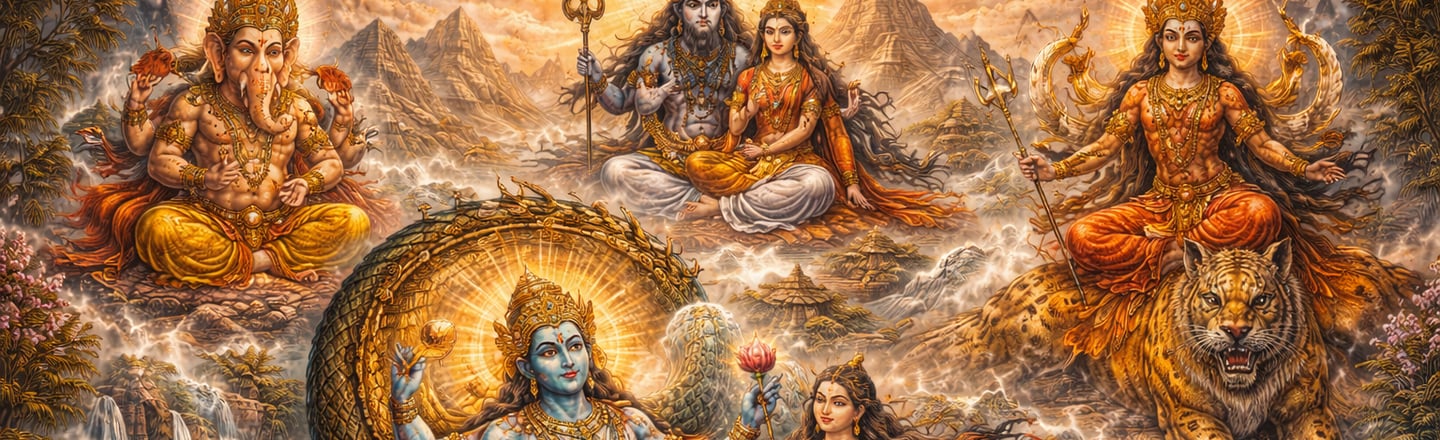
In one of the most beautiful and widely reproduced creation myths, Vishnu lies sleeping on the cosmic ocean in the interval between universes, resting on the great serpent Shesha or Ananta, Infinity, whose thousand hoods spread above him like a canopy. As the new cosmic cycle begins, a lotus grows from Vishnu's navel, and from the lotus Brahma is born. Brahma, opening his four eyes and looking in the four directions, sees only the cosmic ocean and the serpent and the sleeping form from whose navel he has emerged. He sets about creating the universe, first the fundamental categories of existence, then the material elements, then living beings, the gods, and ultimately humanity.
This image, Brahma born from the lotus of Vishnu's navel, creating the world while Vishnu sleeps, is one of the most iconographically powerful in all of Hindu art, and it encodes a philosophical position of considerable sophistication: the creative act is not the most fundamental reality but is itself sustained by a deeper ground, the preserving presence of Vishnu beneath it, and that presence is in turn an expression of the absolute reality of Brahman beyond all personal divine form.
Brahma is depicted with four faces looking in the four directions, a form said to have resulted from his desire to see the beautiful Saraswati, the goddess of knowledge and creative arts who emerged from him as his consort, as she moved around him, and four arms carrying the Vedas, a water pot, a string of beads, and a lotus. His diminished role in actual Hindu devotional practice, he is acknowledged as creator but almost never the object of direct worship or devotion in the way that Vishnu and Shiva are, reflects a characteristic Hindu theological intuition: the creator of the conditioned world is less ultimately real than the ground from which creation emerges and to which it returns.
Vishnu: The Preserver and His Descents
Vishnu, the All-Pervading, the Preserver, is the divine figure most directly engaged with the human world in the Hindu mythological tradition. Where Brahma creates from a divine remove and Shiva destroys at the end of cosmic cycles, Vishnu is the god who enters history, who descends into the world when it is threatened by evil or disorder, who takes on flesh and mortality to fight for the preservation of righteousness. His great mythological cycle is the cycle of the Avatars, the descents, the incarnations, each one a response to a specific cosmic crisis, each one a different expression of the divine capacity to take form for the protection of the world.
The ten principal avatars, the Dashavatara, trace an evolutionary sequence that has fascinated modern interpreters for its apparent parallel to biological evolution: from the Fish (Matsya) who saves humanity and the Vedas from a primordial flood, to the Tortoise (Kurma) who supports the churning of the cosmic ocean, to the Boar (Varaha) who dives to the cosmic depths to rescue the earth goddess, to the Man-Lion (Narasimha) who defeats a demon king through the loophole of his boon of invulnerability, to the Dwarf (Vamana) who grows to cosmic size to reclaim the three worlds from a demon king who has taken them, to Parashurama the warrior-brahmin, to Rama the ideal king, to Krishna the divine lover and teacher, to Buddha, a remarkable inclusion that reflects Hinduism's absorption of the Buddhist tradition, and finally to Kalki, the avatar yet to come, who will appear at the end of the Kali Yuga on a white horse to destroy evil and initiate a new cosmic cycle.
The inclusion of Buddha among Vishnu's avatars is characteristically Hindu in its inclusivity, and in its theological confidence. The tradition does not acknowledge Buddhism as a separate and competing religion but absorbs it as a chapter in the ongoing story of Vishnu's engagement with the world, simultaneously honoring and subordinating it.
Rama: The Ideal King and the Perfect Wife
The Ramayana of Valmiki, one of the two great Sanskrit epics, traditionally attributed to the sage Valmiki and probably reaching its present form between the fifth century BCE and the second century CE, narrates the life of Rama, the seventh avatar of Vishnu, in a story that has shaped the moral, aesthetic, and political imagination of South and Southeast Asia for more than two thousand years.
Rama is the crown prince of Ayodhya, beloved of his people, the embodiment of dharma, righteous order, duty, cosmic law, in human form. On the eve of his coronation he is exiled to the forest for fourteen years through the scheming of one of his father's wives, who invokes a boon the king once promised her. Rama accepts the exile without bitterness or resentment, as the proper expression of his duty to his father's word. His wife Sita insists on accompanying him despite his protests; his devoted brother Lakshmana follows as well. Together they live in the forest as ascetics, encountering sages and demons, until the demon king Ravana, the greatest villain in the Hindu mythological tradition, a being of enormous learning and spiritual accomplishment who has fallen through the corruption of desire, abducts Sita and carries her to his island kingdom of Lanka.
The remainder of the Ramayana narrates Rama's search for Sita, his alliance with the monkey king Sugriva and the monkey general Hanuman, the great war against Ravana and his demon army, Sita's rescue, and their return to Ayodhya. The battle between Rama's forces and Ravana's armies is narrated with epic grandeur, divine weapons of catastrophic power, single combats between warriors of superhuman ability, the intervention of divine beings on both sides, and culminates in Rama's killing of Ravana with the Brahmastra, the divine weapon of absolute destruction.
But the Ramayana's moral complexity does not end with Ravana's defeat. Sita, having lived in another man's kingdom for months, is required to prove her purity through an ordeal of fire, she enters the flames, and the fire god Agni returns her unharmed, testifying to her perfect chastity. They return to Ayodhya in triumph. And then, in the version that has troubled readers and commentators for centuries, Rama, yielding to the gossip of his subjects who cannot believe in Sita's purity, banishes her to the forest again, even though she is pregnant with his children. She gives birth in the hermitage of Valmiki himself, raises their sons there, and ultimately, when Rama attempts a final reconciliation, asks the earth her mother to open and receive her back rather than endure further humiliation.
The Sita of the Ramayana has been interpreted in an enormous range of ways, as the ideal of feminine virtue and self-sacrifice, as a victim of patriarchal injustice, as a goddess whose divine nature ultimately transcends the human world that cannot adequately honor her. The tradition has never settled on a single reading, and the story's refusal to provide a comfortable resolution to the tension between Rama's righteousness and his failure as a husband is one of the sources of its enduring power.
Hanuman, the monkey general, the devoted servant of Rama, is among the most beloved figures in all of Hindu mythology, a being of enormous physical power, perfect devotion, and profound wisdom whose total surrender to Rama is understood in the devotional tradition as the purest possible expression of bhakti, the path of loving devotion to the divine. When asked where Rama dwells, Hanuman tears open his chest to reveal Rama and Sita enshrined in his heart. The image of Hanuman, flying through the air carrying a mountain, leaping across the ocean to Lanka, bowing in absolute surrender before his lord, is one of the most ubiquitous and beloved in all of Hindu iconography.
Krishna: The Divine Lover and the Teacher of the Gita
Krishna, the eighth avatar of Vishnu, the Dark One, the Butter Thief, the Flute Player, the divine friend and charioteer, is the most mythologically elaborate and devotionally beloved figure in the entire Hindu tradition, a being whose mythology encompasses the full range of human experience from the most playful to the most philosophically profound.
His birth is attended by cosmic portents: the tyrant king Kamsa, warned by prophecy that his nephew would kill him, has imprisoned his sister Devaki and her husband Vasudeva and killed their children one by one. Krishna is born at midnight in the prison cell, and Vasudeva carries the infant across the flooding Yamuna river, the waters parting before him, the great serpent Shesha shielding the baby from rain, to the village of Vrindavan, where he is raised by the cowherd couple Yashoda and Nanda among the gopas and gopis, the cowherds and cowherd women whose simple, loving, totally unselfconscious devotion to Krishna became the model for the highest form of bhakti in the devotional tradition.
The stories of Krishna's childhood and youth in Vrindavan are among the most exquisitely beautiful mythological narratives in any tradition, the infant Krishna overturning butter pots and eating the butter, his mother Yashoda tying him to a mortar as punishment only to have him drag it between two trees, uprooting them to reveal the celestial beings imprisoned within; the young Krishna playing his flute by the Yamuna river in the moonlight while the gopis abandon their households, their sleeping husbands, their ordinary lives, and run to dance with him in the forest in the great circle dance called the Rasa Lila. This last image, the divine flute player whose music is so beautiful that it draws all of creation toward him in irresistible longing, is perhaps the central image of the Vaishnava devotional tradition: the world as a dance of divine love, consciousness drawn back toward its source by a beauty that is simultaneously utterly particular and absolutely universal.
Krishna's mythology also contains its profound darkness. He kills Kamsa. He participates in the great war of the Mahabharata as the charioteer and divine friend of the hero Arjuna, and it is on the battlefield of Kurukshetra, before the two armies face each other, that he delivers the Bhagavad Gita, the Song of the Lord, the single most influential philosophical and spiritual text in Hindu civilization.
The Bhagavad Gita is embedded within the Mahabharata as an episode, Arjuna, seeing his kinsmen and teachers arrayed on the opposing side, is paralyzed by grief and refuses to fight. Krishna's response to Arjuna's crisis is one of the most comprehensive and systematically organized presentations of Hindu philosophy ever composed, encompassing the nature of the self and the absolute, the paths of action, devotion, and knowledge, the doctrine of karma and dharma, the nature of duty without attachment to its fruits, and the ultimate relationship between the individual soul and the divine. The Gita does not resolve these themes into a single simple answer, it holds them in a creative tension that reflects the full complexity of the tradition, but its central teaching, nishkama karma, action without attachment to results, performed as an offering to the divine, became one of the most influential ethical and spiritual principles in world religious thought.
Shiva: The Great Lord and the Power of Dissolution
Shiva, Mahadeva, the Great God, the Destroyer, the Lord of the Dance, the great ascetic, the divine husband, is the most paradoxical and philosophically challenging figure in the Hindu mythological tradition, a deity whose nature encompasses what seem like absolute contradictions: supreme asceticism and erotic power, fierce destruction and boundless compassion, the wildness of the wandering renunciant and the stability of the perfect householder, the god who destroys the universe and the god who holds the poison that would destroy it in his throat, turning it blue, protecting the world through his capacity to absorb what would kill everything else.
Shiva's iconography encodes his paradoxical nature in visual form of extraordinary richness. He sits in deep meditation on Mount Kailash, his body smeared with ash from cremation grounds, his matted hair piled high and bearing the crescent moon and the river Ganga, which he received in his hair to break its world-destroying fall to earth. Around his neck coils the serpent Vasuki. His third eye in the center of his forehead can destroy anything it opens upon, including the god of desire Kama, whom he burned to ash when Kama's arrow disturbed his meditation. He carries the trident Trishula and the drum Damaru whose rhythm is the rhythm of creation. His vehicle is the great white bull Nandi.
The myth of Shiva as Nataraja, the Lord of the Dance, is one of the most philosophically concentrated mythological images in world religious art. The bronze sculptures of South Indian tradition show Shiva dancing within a ring of fire, one foot raised and one foot pressing down on the demon Apasmara, who represents ignorance and forgetfulness. His four arms hold fire, a drum, perform gestures of protection and gift. His dance, the Tandava, is simultaneously the dance of creation, preservation, and dissolution: the entire cosmic process expressed in the movement of a single dancing body. The ring of fire is both the cosmos and its destruction. The drum beat is the first sound of creation, the primordial Om from which all existence unfolds. The foot pressing down on ignorance is the grace that liberates consciousness from the cycle of suffering. In this single image, the Hindu mythological tradition achieved a synthesis of philosophy, cosmology, and devotion of breathtaking completeness.
Shiva's consort, the goddess in her many forms, is as important to his mythology as Shiva himself, and the relationship between them is the central drama of the Shaiva tradition. As Parvati, she is the devoted wife who wins Shiva through years of ascetic practice, eventually drawing him from his meditation into domesticity and the life of the perfect householder. As Durga, she is the warrior goddess who defeats the buffalo demon Mahishasura and the terrible demon generals who the male gods could not overcome, a myth that celebrates the supreme power of the feminine principle in its protective, fierce aspect. As Kali, black-skinned, wild-haired, garlanded with severed heads, standing on the prone body of Shiva himself, she is the force of absolute dissolution, time devouring all things, the darkness beyond which there is only the light of pure consciousness.
The Devi: The Great Goddess
The tradition of the Devi, the goddess in her supreme form as the ultimate reality behind all divine manifestation, represents one of Hinduism's most philosophically radical and devotionally powerful contributions to world mythology. The Devi Mahatmya, a text embedded within the Markandeya Purana and probably composed around the fifth or sixth century CE, presents the most concentrated and powerful statement of this theology: the Great Goddess is not a subordinate female figure alongside the male gods but the primordial reality from which all gods and all existence emerge, whose power, Shakti, is the energy that animates every divine and cosmic process.
In the central myth of the Devi Mahatmya, the gods are defeated by the demon Mahishasura, who has obtained a boon making him invulnerable to any male being. The gods, unable to defeat him, combine their divine energies, their own tejas or brilliance, into a single blazing mass from which the Goddess emerges, armed by each god with a copy of his own divine weapon, mounted on a lion. Her battle with Mahishasura and his demon armies is narrated with tremendous martial energy and visual power, culminating in the Goddess's slaying of the buffalo demon in a passage of mythological violence that is simultaneously terrifying and, in the tradition's understanding, supremely auspicious, the destruction of the ego and the delusions that bind consciousness to the cycle of suffering.
The myth communicates, in narrative form, a philosophical position of the greatest importance: that the power by which the universe is created, preserved, and dissolved is fundamentally feminine, that the male gods are expressions of this feminine power rather than its source, and that the proper response to the mystery of existence is surrender to the Goddess rather than domination of the natural world.
The Ocean of Stories
Hindu mythology ultimately defies summary not because it is confused or contradictory, though it contains real tensions and genuine contradictions, but because it is genuinely inexhaustible. Every story leads to another story. Every figure contains within it multiple figures. Every philosophical position generates its counter-position, and both are held within a tradition spacious enough to contain them without forcing resolution.
The eleventh-century Kashmiri text Kathasaritsagara, the Ocean of Streams of Story, takes its title from a vision of mythology as a body of water without shores, fed by countless tributaries, itself feeding countless others. This is perhaps the most honest image of what Hindu mythology actually is: not a doctrine or a canon but an ocean, vast, deep, dangerous in places, nourishing in others, containing within its depths things of beauty and things of terror and things whose nature cannot be determined from the surface.
To enter this ocean, even briefly, is to encounter the full range of what human beings have imagined about existence, its origins, its meaning, its suffering, its beauty, its ultimate nature, expressed with a freedom and an abundance that no other tradition has quite matched. It is a mythology that says: the universe is larger than any story told about it, the divine is more various than any theology has captured, and the human capacity for wonder, properly cultivated, properly directed, is itself a form of the sacred
480-366-3550 (Domain Sales)
© SDBEST LLC, 2025. All rights reserved.
Sponsorship Disclosure
Terms of Service