Japanese Mythology: The Islands Born from the Gods
A Mythology of Beauty, Purity, and Sacred Presence
Japanese mythology emerges from a cultural and geographical context as distinctive as any that has shaped a mythological tradition, a chain of volcanic islands at the edge of the Pacific, swept by typhoons and shaken by earthquakes, surrounded by a sea of extraordinary beauty and unpredictable danger, covered in forests of dense green that seem to hold presences just beyond the threshold of ordinary perception. This is a landscape that insists on the sacred, that makes it nearly impossible to separate the beautiful from the numinous, the natural from the divine. The Japanese mythological tradition reflects this insistence at every level: it is a mythology in which the gods are not primarily transcendent beings dwelling above the world but presences within it, in the storm, the mountain, the river, the twisted old tree, the fox moving at the edge of the rice field at dusk.
The primary sources for Japanese mythology are the Kojiki, the Record of Ancient Matters, compiled in 712 CE, and the Nihon Shoki, the Chronicles of Japan, completed in 720 CE. Both were commissioned by the imperial court and compiled by court scholars from older oral traditions, regional myths, and clan genealogies, and both served the explicit political purpose of legitimizing the imperial dynasty by tracing its descent from the sun goddess Amaterasu and through her from the very first creative act of the cosmos. This political function does not diminish the mythological richness of what these texts contain; it simply means that what has been preserved reflects the priorities of the Yamato court and the traditions that court chose to elevate, while regional and clan traditions that did not serve those priorities were recorded imperfectly or not at all.
Japanese mythology also exists in creative tension with the two other great spiritual traditions that shaped Japanese civilization, Buddhism, which arrived from the Korean Peninsula in the sixth century CE and profoundly transformed Japanese religious life, and Taoism and Confucianism, whose influence came primarily through China and shaped Japanese philosophy, governance, and aesthetic sensibility. The indigenous tradition, now called Shinto, the Way of the Gods, was never entirely replaced by these imports but entered into a complex synthesis with them that produced the characteristically Japanese religious sensibility: pragmatic, aesthetically refined, comfortable with multiple overlapping spiritual frameworks, deeply attentive to the particular sacred presence of specific places and natural phenomena.
In the Beginning: The Separation of Heaven and Earth
The Kojiki opens with a cosmogony of spare, elegant beauty, a creation narrative that establishes from the very first lines the characteristic Japanese mythological sensibility of attentiveness to process, to emergence, to the gradual differentiation of form from formlessness.
In the beginning, heaven and earth were not yet separated, all was a chaotic, undifferentiated mass. Then, as things began to take form, the lighter, clearer elements rose to become the heavens, while the heavier, denser elements sank to become the earth. The earth at this stage was young and unformed, floating like oil, drifting like a jellyfish. From the interaction of heaven and earth, the first gods came into being spontaneously, the Separate Heavenly Deities, who existed briefly and then concealed themselves. Two more generations of divine beings emerged and concealed themselves in turn.
What is immediately striking about this cosmogony is its modesty and its attention to natural process. There is no single creator god imposing form on chaos by act of will. The cosmos differentiates itself, as if following its own inherent tendency toward articulation, and the first gods emerge from this differentiation without fanfare or dramatic action, existing briefly and withdrawing. Creation in the Japanese mythological tradition is less an event than an unfolding, a gradual coming into clarity of what was implicit in the original undifferentiated state.
The first gods to act with genuine creative intention are Izanagi and Izanami, He Who Invites and She Who Invites, a divine couple who are commanded by the Heavenly Deities to complete the creation of the world. They are given a jeweled spear and stand on the Floating Bridge of Heaven, stirring the churning ocean below. When they lift the spear, the brine that drips from its tip coagulates to form the first island, Onogoro, the island that forms itself. They descend to this island and, after an initial misstep that the mythology addresses with characteristic directness, Izanami speaks first in their courtship ritual, violating the principle that the male should initiate, and their first offspring are malformed; they consult the Heavenly Deities and repeat the ritual correctly, they begin giving birth to the islands of Japan and to the first generation of nature deities.
The birth of the Japanese islands is one of the most beautiful and nationally resonant moments in the tradition: the specific islands of the Japanese archipelago are not made but born, children of the divine couple, sacred presences whose particular character reflects their divine parentage. Japan is not a territory conquered or settled; it is a family, born of gods, inherently sacred in every particular.
The Death of Izanami and the First Descent to the Underworld
The creation narrative takes its first tragic turn with the birth of Kagutsuchi, the fire god, whose burning body kills Izanami as she gives birth to him. This death, the first death in the Japanese mythological world, introduces the theme of the contamination of death and the grief of loss into a tradition that had previously known only the clean, fresh beauty of creation.
Izanagi, consumed by grief and rage, kills the fire god, his divine blood and dismembered body giving rise to numerous new deities as it falls, and then makes the decision that produces one of the most haunting mythological episodes in the Japanese tradition: he descends to Yomi, the underworld, to retrieve his dead wife.
The myth of Izanagi's descent to Yomi follows the archetypal pattern of the descent to the underworld found across world mythology, from Orpheus to Inanna to Persephone, but handles it with a distinctive Japanese sensibility centered on the concept of kegare, ritual pollution or impurity. Izanagi finds Izanami in the darkness and she speaks to him from the shadows: she has already eaten the food of the underworld and cannot simply return, but she will speak to the gods of Yomi on his behalf. She asks him, with great urgency, not to look at her.
He waits. The wait becomes unbearable. He breaks the prohibition, as such prohibitions are always broken in these myths, and lights a tooth of his comb as a torch. What he sees is Izanami's body in an advanced state of decomposition, writhing with maggots, the eight thunder gods born from her rotting flesh. He flees in horror. Izanami, enraged and humiliated at being seen in her pollution, sends the shikome, the foul women of the underworld, and then the thunder gods in pursuit. Izanagi runs, throwing obstacles behind him to slow the pursuit, a bunch of grapes that become food, a comb that becomes bamboo, before finally reaching the border between Yomi and the living world and blocking it with a great boulder.
Standing on either side of this boulder, Izanagi and Izanami speak their final words to each other. She threatens to kill a thousand people each day; he responds that he will cause fifteen hundred births. This exchange establishes the mythological foundation of the balance between death and birth that sustains the human world, a balance maintained not by divine benevolence but by the grief and anger of a separated couple, their last communication a negotiation of the terms of mortality.
Izanagi emerges into the living world and immediately performs ritual purification, washing off the pollution of the underworld in a river. This act of cleansing generates some of the most important deities in the Japanese pantheon: from the washing of his left eye comes Amaterasu, the sun goddess; from his right eye comes Tsukuyomi, the moon god; from his nose comes Susanoo, the storm god. The three great governing deities of the Japanese cosmos are born from an act of purification after an encounter with death and decay, a mythological statement that the sacred emerges from the confrontation with pollution, that the clean and luminous come into being only through the prior experience of their opposite.
Amaterasu and the Cave: Light Withdrawn and Restored
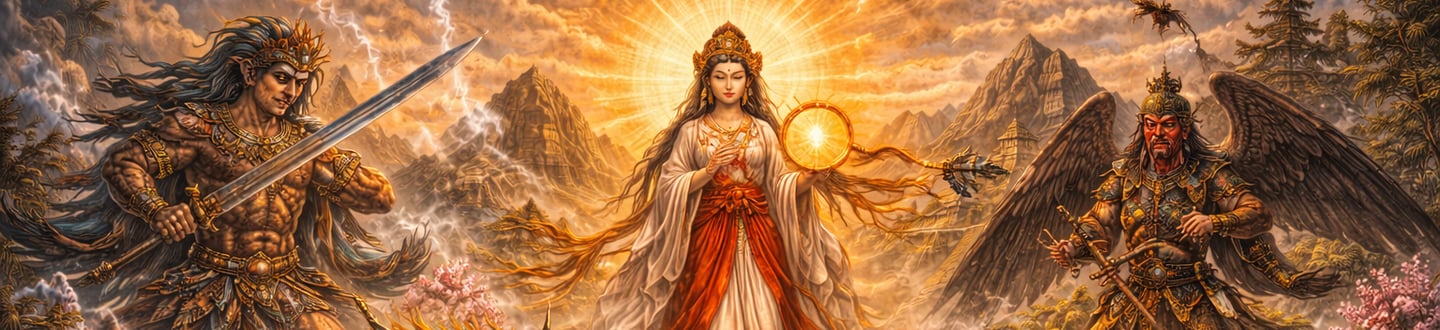
The myth of Amaterasu's withdrawal into the Rock Cave of Heaven is one of the most celebrated and symbolically rich narratives in the Japanese tradition, a myth of the loss of light, the devastation of a world without the sun, and the communal effort required to restore what has been withdrawn.
The immediate cause of the crisis is the behavior of Susanoo. Assigned to rule the seas after the death of Izanami, or in some accounts, weeping constantly for his dead mother and neglecting his domain, Susanoo is eventually banished from the heavens. Before his departure he goes to take leave of his sister Amaterasu, whose domain in the High Plain of Heaven is adjacent to his. Amaterasu suspects his motives and arms herself for battle. The two engage in a contest of divine procreation, exchanging objects and generating deities from them, that Susanoo wins in a way that Amaterasu accepts, but then Susanoo's behavior becomes increasingly destructive: he fills in the rice paddies, destroys the boundaries between fields, defiles Amaterasu's sacred weaving hall. When one of Amaterasu's weaving maidens dies in the commotion, startled and wounded by a piece of the heavenly horse Susanoo throws through the roof, Amaterasu retreats in grief and anger into the Rock Cave of Heaven, blocking the entrance with a great boulder.
The world goes dark. Crops fail. Evil spirits run rampant. The eight million gods of heaven assemble in consternation and council, the same quality of divine deliberation that appears in the Mayan creation myth, the sense that cosmic crisis requires communal response. They try various measures to entice the sun goddess back: they collect roosters whose crowing should herald the dawn, they hang a great mirror and magnificent jewels in a tree outside the cave, they perform sacred rituals. But the decisive act is performed by Ame-no-Uzume, the divine shamaness, who mounts a tub and begins a dance that becomes increasingly ecstatic and risqué, finally exposing herself to the assembled gods. The eight million deities burst into uproarious laughter.
Amaterasu, puzzled by the laughter in what should be a devastated world without her light, opens the cave slightly to look, and is dazzled by her own reflection in the mirror hanging in the tree. At this moment of distraction, the strong god Ame-no-Tajikarao pulls her fully out of the cave, and another deity quickly stretches a rope across the entrance to prevent her return. Light is restored. The world lives again.
This myth operates on multiple levels simultaneously. It is a seasonal myth, the sun's withdrawal encoding the fear of winter's permanent darkness. It is a myth about the power of communal laughter and bodily joy to restore what isolation and grief have withdrawn. It is a myth about the sacred mirror, the yata no kagami, which along with the sacred sword Kusanagi and the sacred jewels yasakani no magatama forms the Three Imperial Regalia of Japan, the sacred objects that legitimize the imperial throne. And it is a myth about the relationship between the sacred and the performative, the insight that what draws the divine back into the world is not solemn petition but the irresistible pull of life in full, unashamed expression.
Susanoo, Orochi, and the Sword from the Dragon
Expelled from heaven after his destructive behavior, Susanoo descends to the earth province of Izumo, where he encounters an elderly couple weeping beside a river. Their story reveals the situation: they have had eight daughters, and each year the eight-headed serpent Yamata no Orochi has come to devour one. Seven daughters have been taken; only one, Kushinada-hime, remains, and Orochi will come again. Susanoo, who in heaven had been a figure of destructive chaos but who on earth will prove to be a hero, offers to slay the serpent in exchange for Kushinada-hime's hand in marriage.
His method is quintessentially cunning. He instructs the couple to brew eight vats of sake, eight times refined, the most potent possible. Eight platforms are built, each bearing a vat of sake. Orochi arrives, its eight heads lowering to drink from the eight vats, and while the serpent is stupefied by sake, Susanoo cuts it to pieces with his sword. In the middle tail of the serpent his blade strikes something hard, another sword, Kusanagi no Tsurugi, the Grass-Cutting Sword, one of the Three Imperial Regalia, which Susanoo presents to Amaterasu as a gift of reconciliation.
The myth of Susanoo and Orochi is one of the most structurally clean and satisfying in the Japanese tradition, the hero, the monster, the threatened maiden, the clever trap, the unexpected treasure in the monster's body. But it also accomplishes several mythological tasks simultaneously: it explains the origin of the sacred sword, it establishes Izumo as a region of particular divine significance, and it begins the rehabilitation of Susanoo from the chaotic destroyer of heaven to the culture hero of earth, a transformation that maps remarkably well onto the psychological archetype of the creative force that must be expelled from the domestic order before it can achieve its proper heroic expression.
The Kami: A World Alive with Sacred Presence
Underlying all of Japanese mythology is the concept of kami, the sacred presences that inhabit the natural world, that animate specific places, objects, and natural phenomena, that are honored and appeased through the rituals of Shinto practice. The word kami is often translated as "gods" or "spirits," but neither translation is quite accurate. Kami are not primarily transcendent beings who created the world and rule it from above; they are presences within the world, indwelling qualities of particular places and things that can be perceived, honored, and entered into relationship with.
The Kojiki famously speaks of yaoyorozu no kami, the eight million gods, or more idiomatically the innumerable gods, a formulation that expresses the Japanese mythological intuition that sacred presence is not concentrated in a few specific beings but distributed throughout the entire fabric of existence. The mountain has its kami. The river has its kami. The ancient tree, the distinctive rock, the waterfall, all are potential sites of kami presence. Even particularly powerful or skillful human beings may become kami after death, their spirits continuing as presences that can bless or harm the living.
This understanding of the world as permeated with sacred presence, every particular thing potentially animated by a quality that demands respect and careful relationship, is perhaps the deepest and most enduring contribution of Japanese mythology to human religious imagination. It produces a characteristic attentiveness to the specific, the local, the particular: not the transcendent light that illuminates everything equally from above, but the specific quality of light at a specific shrine in a specific season, the particular character of this mountain rather than mountains in general, the kami of this household's hearth rather than a universal fire deity.
Oni, Tengu, Kitsune, and the World of Supernatural Beings
Japanese mythology produced, alongside its creation narratives and divine genealogies, an extraordinarily rich bestiary of supernatural beings whose stories populated the popular imagination and whose presence shaped the texture of daily life in ways that the high theological mythology of the Kojiki did not quite reach.
Oni, the demons or ogres of Japanese mythology, were fearsome beings associated with illness, disaster, and the punishment of the wicked, depicted as enormous humanoid figures with horns, wild hair, and the fanged mouths of predators, dressed in tiger skins and carrying iron clubs. They were the agents of Emma, the king of the underworld, assigned to torment the sinful dead, a role that reflects the influence of Buddhist cosmology on Japanese supernatural belief. But oni were not simply infernal punishment machines; they appeared in folk tales as creatures who could be tricked or reformed, and the ritual of Setsubun, in which beans are thrown to drive out oni and invite good fortune, is one of the most ancient and beloved of Japanese seasonal observances.
Tengu, winged mountain spirits depicted with either bird-like faces or the long noses of the karasu tengu tradition, occupied an ambivalent position in the mythology, associated simultaneously with the martial arts and mountain asceticism and with arrogance, deception, and the confusion of unwary travelers. The greatest warriors in Japanese legend were sometimes said to have been trained by tengu; the famous swordsman Minamoto no Yoshitsune was taught his skills by the tengu king Sōjōbō on Mount Kurama.
Kitsune, the fox spirit, is among the most beloved and complex figures in Japanese supernatural tradition, a being of shapeshifting intelligence that could appear as a beautiful woman, a scholar, a monk, or any form suited to its current purpose. Fox spirits accumulated wisdom and magical power with age, eventually growing additional tails, the most powerful kitsune had nine tails and were near-divine in their abilities. They were associated with Inari, the kami of rice, fertility, industry, and worldly success, whose shrines, instantly recognizable by their rows of vermillion torii gates, are among the most numerous in Japan. The relationship between kitsune and Inari is complex and regionally variable, but the fox's intelligence, adaptability, and ambivalent relationship to human society made it a natural expression of the ambiguous quality of divine blessing: generous and dangerous, helpful and deceptive, intimately close to human life and permanently other.
The Enduring Landscape
Japanese mythology ultimately returns to the landscape that generated it, the islands themselves, born of divine parentage, alive with kami presence, beautiful and dangerous in ways that cannot be separated from each other. The volcano and the cherry blossom, the typhoon and the still surface of the garden pond, the earthquake's sudden reminder that the ground beneath civilization is alive and autonomous, all of these feed a mythological sensibility that has never fully accepted the separation between the human world and the divine world that other traditions have sometimes imposed.
This inseparability of the beautiful and the sacred, the natural and the numinous, the particular and the cosmic, is perhaps what Japanese mythology offers most distinctively to the world's mythological imagination: the reminder that the divine is not elsewhere, not above or below or behind the visible world, but here, in the specific, unrepeatable quality of this moment, this place, this presence, and that the appropriate response to that recognition is not theology but attentiveness, not doctrine but the careful, grateful perception of what is actually there.
480-366-3550 (Domain Sales)
© SDBEST LLC, 2025. All rights reserved.
Sponsorship Disclosure
Terms of Service