Mayan Mythology: The Story the Universe Tells Itself
A Mythology Written in Stone, Stars, and Blood
Mayan mythology emerges from one of the most intellectually and artistically sophisticated civilizations in the ancient world, a civilization that built cities of breathtaking scale and refinement in the rainforests of Mesoamerica, that developed one of the only fully realized writing systems in the ancient Americas, that achieved a mastery of astronomical observation and mathematical calculation that was, in several respects, more precise than anything being done in Europe at the same time, and that wove all of this intellectual achievement into a mythological vision of extraordinary coherence and depth. To encounter Mayan mythology is to encounter a civilization that thought about the cosmos with the full force of its intelligence, that looked at the stars not merely with wonder but with rigorous, sustained attention, and that built its understanding of time, creation, human obligation, and sacred history on the foundation of what it found there.
The Maya were never a single unified empire in the manner of the Aztecs or the Incas. They were a constellation of city-states, Tikal, Palenque, Copán, Chichén Itzá, Uxmal, and dozens of others, sharing a common cultural and linguistic heritage while maintaining distinct political identities, artistic traditions, and local religious emphases. Their civilization flourished across what is now southern Mexico, Guatemala, Belize, Honduras, and El Salvador, reaching its greatest cultural heights during the Classic Period from roughly 250 to 900 CE before undergoing a partial collapse that remains one of the most debated questions in archaeology, followed by a continuation of Mayan culture in the Postclassic Period that was still very much alive when the Spanish arrived in the sixteenth century. The Maya of today, millions of people speaking dozens of Mayan languages across the same territories, are the living descendants of this civilization, and the mythological tradition did not end with the conquest but continued, transformed and partly hidden, alongside and within the imposed framework of Spanish Catholicism.
Our knowledge of Mayan mythology rests on several extraordinary sources. The Popol Vuh, the Council Book of the K'iche' Maya, written down in the mid-sixteenth century by indigenous scholars using the Roman alphabet to preserve what had previously been maintained in hieroglyphic books and oral tradition, is the most complete and literarily magnificent mythological text to survive from the ancient Americas, a work whose narrative sophistication and philosophical depth place it among the great mythological documents of world civilization. The surviving hieroglyphic inscriptions on monuments, temples, and ceramics, now largely deciphered, provide a complementary body of mythological material, much of it focused on the cosmological significance of specific historical events and royal rituals. The Dresden, Madrid, and Paris Codices, three of the few Mayan hieroglyphic books that survived the wholesale destruction ordered by Bishop Diego de Landa in 1562, one of the great cultural atrocities of the colonial period, contain astronomical tables, ritual calendars, and mythological content of immense importance. Together these sources allow a partial but genuinely illuminating view into one of history's most original mythological traditions.
The Popol Vuh: Creation as Collaboration
The Popol Vuh opens with one of the most beautiful creation passages in any mythological tradition, a description of the state before creation that communicates, with remarkable precision and poetic power, the nature of absolute potentiality:
Before the world existed, there was only the sky and the sea, and in the darkness the Creator gods held council. Everything was in suspense, in silence, at rest, in stillness. There was nothing yet that moved or breathed or made noise. The face of the earth had not yet appeared; there was only the calm sea and the sky above it, and nothing was yet in its place. There was no sound, no motion, only the murmuring of the gods in the darkness, discussing what was to be made and how it should be done.
This image, gods in council before creation, speaking the world into existence through collective deliberation, is one of the most distinctive elements of Mayan cosmological thinking. Creation in the Popol Vuh is not the act of a single all-powerful deity but a collaborative project, undertaken by multiple divine beings whose consultations, disagreements, and successive attempts produce a cosmos that is the result of genuine creative effort rather than effortless omnipotence. The gods say "Earth," and the earth appears. They say "Mountain," and mountains form. The sea draws back, and the land emerges. But this initial creation is only a beginning, a framework waiting to be populated with beings who can worship and sustain the divine creators, and the process of finding and making such beings will constitute the central drama of the Popol Vuh's creation narrative.
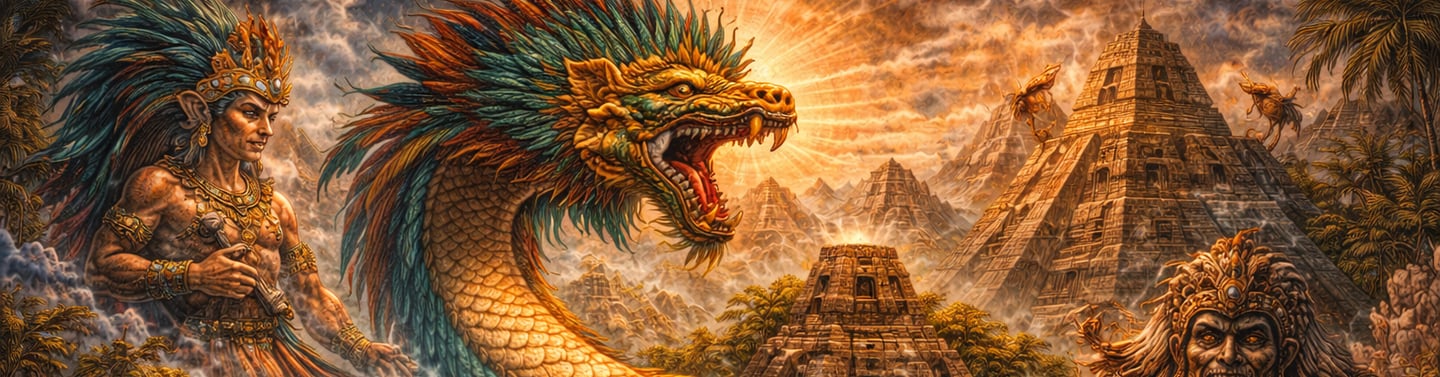
The principal creator figures in the Popol Vuh are Tepeu and Gucumatz (the K'iche' equivalent of Quetzalcóatl, the Feathered Serpent), along with the heart of heaven Huracán, whose name, meaning "one leg," entered the European languages through Spanish as huracán and ultimately as the English word hurricane. These figures represent aspects of a divine creative intelligence that is both unified and multiple, operating through consultation and co-creation rather than divine fiat.
The Three Failed Creations and the Making of the Corn People
The creation narrative of the Popol Vuh is structured, like the Aztec myth of the Five Suns, around a series of failed attempts before the successful creation, but the logic of failure and the final solution are distinctively Mayan and philosophically fascinating.
The first creation produced beings from mud, but they could not hold their form, could not move properly, could not speak, and dissolved when wet. The gods dissolved this creation and tried again. The second attempt produced beings carved from wood, zots'ilaha, the wooden people, who could speak and walk and populate the earth, but who had no memory, no understanding of their creators, no blood in their veins, no moisture in their faces. They went through the motions of life without genuine consciousness or gratitude. The gods decided to destroy them, and the destruction was apocalyptic: a great rain of resin fell from the sky, the animals rose against them, even their tools and cooking pots rebelled, citing their abuse. The wooden people fled and were transformed, those who escaped became the monkeys in the trees, which is why monkeys resemble human beings.
The third and successful creation produced human beings from masa, ground maize, corn. The Four Mothers and Four Fathers of humanity were formed from white and yellow corn that Xmucané, the divine grandmother, ground nine times to make the dough from which their flesh was shaped. These beings were complete: they could see, think, speak, and most importantly they possessed genuine understanding, gratitude, and the capacity for worship. In fact they could see too well, they could perceive the entire cosmos, understood everything, saw as the gods saw, and the gods, concerned that beings with divine perception would not be properly humble, breathed a cloud over their eyes, dimming their vision to human range, like the breath that fogs a mirror.
The identification of humanity with corn is one of the deepest and most enduring mythological statements in the Mayan tradition, and, given the actual agricultural and nutritional reality of Mesoamerican civilization, one of its most literally true. Maize was not simply a crop; it was the foundation of civilized life, the substance without which the Maya and their neighbors could not have built their cities or sustained their populations. To say that human beings are made of corn is to say that civilization is possible only because of the gift of agricultural abundance, and that the proper response to that gift is care, attention, gratitude, and the ritual reciprocity that keeps the cycle of planting and harvest, death and renewal, continuously turning.
The Hero Twins: Hunahpu and Xbalanque
The narrative heart of the Popol Vuh, and one of the great adventure mythologies of world literature, is the story of the Hero Twins, Hunahpu and Xbalanque, whose exploits against the lords of the underworld constitute both a cosmic myth of death and resurrection and a brilliantly entertaining narrative full of humor, ingenuity, and genuine suspense.
The story begins with the twins' father and uncle, One Hunahpu and Seven Hunahpu, who were great ballplayers. Their noise disturbed the lords of Xibalba, the underworld, who summoned them to play ball in the underworld court and killed them through a series of treacherous tests. One Hunahpu's head was placed in a tree, where it became a skull that spit into the hand of Xquic, a maiden of the underworld, miraculously impregnating her with the Hero Twins. Xquic escaped from Xibalba and gave birth to Hunahpu and Xbalanque on the surface world, where they grew up to become the most accomplished ballplayers and tricksters the world had ever seen.
The twins' descent into Xibalba to avenge their father is narrated with extraordinary literary sophistication, a combination of cosmic seriousness and comic virtuosity that is entirely characteristic of Mayan narrative sensibility. The lords of Xibalba, One Death and Seven Death and their terrible subordinates, presiding over houses of darkness, cold, fire, jaguars, and razor bats, subjected every visitor to fatal tests, and had dispatched all previous challengers with ease. But Hunahpu and Xbalanque were different. They saw through every trap. When presented with mannequins dressed as the lords of death, they refused to greet them, knowing they were dummies. When confined in the Dark House, they kept their torch burning but plugged it with a macaw's tail feather so it appeared unlit. They survived the Cold House, the Fire House, and the Jaguar House through intelligence and preparation.
The Bat House proved more dangerous: the bat demon Camazotz cut off Hunahpu's head while he slept, and the lords of Xibalba placed it on the ballcourt as the new ball. But Xbalanque fashioned a substitute head from a gourd, retrieved his brother's real head, and they continued. Ultimately, having defeated the lords of Xibalba repeatedly, the twins performed their greatest trick: they allowed themselves to be sacrificed, having arranged with two divine seers for their resurrection. They were ground to bone meal and scattered in a river, reformed themselves, and returned as disguised performers whose act culminated in the feat of sacrificing one twin and bringing him back to life. The lords of Xibalba, delighted, demanded the trick be performed on them, and the twins obliged the sacrifice but not the resurrection, defeating the lords of death through a trick that is both cosmically significant and darkly comic.
The resurrection of Hunahpu and Xbalanque, and their subsequent ascent to become the sun and moon, establishes the mythological template for the cycle of death and rebirth that governs the Mayan cosmos. The underworld is not a place of permanent defeat but of transformation, a darkness through which the light must pass on its way to rising again. The Hero Twins do not simply overcome death; they demonstrate that death is a passage, that what appears to be final destruction is in fact the prerequisite for a new and higher form of existence.
The Mayan Calendar and the Mythology of Time
No aspect of Mayan civilization has attracted more attention, or more misunderstanding, particularly around the notorious 2012 prophecies that were largely invented by modern interpreters, than the extraordinary Mayan calendar system, which was embedded in a mythological understanding of time of remarkable originality and depth.
The Maya employed several interlocking calendar systems, of which the most important for mythological purposes were the 260-day ritual calendar Tzolk'in and the 365-day solar calendar Haab', whose combination produced the Calendar Round of 52 years, similar in function to the Aztec equivalent. But uniquely among Mesoamerican civilizations, the Maya also employed the Long Count calendar, a linear count of days from a fixed creation date calculated to fall in approximately 3114 BCE by most scholarly reckonings, which allowed them to situate events, including mythological events, at specific points in an enormous expanse of cosmic time.
The Mayan understanding of time was neither purely linear nor purely cyclical but something more complex, a series of nested cycles of different scales, each with its own characteristic qualities, deities, and omens, all embedded within a larger linear progression that gave each moment in time its unique combination of cyclical influences. Time was not an empty container in which events occurred; it was itself a force, a bearer of qualities, a divine presence that shaped the nature of everything happening within it. The day on which a child was born determined aspects of their destiny; the day on which a ritual was performed determined its efficacy; the conjunction of multiple calendar cycles at specific points created moments of heightened cosmic significance.
The creation date of the current world, the beginning of the present Long Count cycle, was understood as the most recent in a series of creations, and the mythological events narrated in the Popol Vuh were understood as having occurred in the time before this creation, setting the conditions for the world that now exists. The sky, the stars, the planets, particularly Venus, which the Maya tracked with extraordinary precision across its complex cycle of appearances as morning and evening star, were not merely astronomical phenomena but mythological actors, divine beings whose movements through the sky re-enacted the great stories of the gods.
The Lords of Xibalba and the Mythology of Death
The Mayan underworld Xibalba, a word meaning "place of fright" in K'iche', was one of the most elaborately conceptualized realms of the dead in any mythological tradition, a nine-level domain presided over by death lords whose names catalogued the specific ways that existence could be brought low: disease, decomposition, jaundice, blood, pus, poverty, suffering. The Mayan confrontation with death was neither the stoic acceptance of the Norse nor the sacrificial urgency of the Aztec but something more akin to a sustained, ingenious, and ultimately triumphant argument with mortality, the conviction that the intelligence and courage that navigated the trials of Xibalba could transform death into the precondition of new life.
The ballgame, played throughout Mesoamerica but invested with particular cosmic significance by the Maya, was understood in mythological terms as the re-enactment of the Hero Twins' contest with the lords of death. The ball represented the sun moving through its daily cycle, descending into the underworld at sunset and rising again at dawn. The players' physical contest in the court re-enacted the cosmic drama of light against darkness, life against death, in a ritual performance whose stakes were understood as genuinely cosmological. The famous scenes on Mayan ceramics of the ballgame being played in Xibalba, of decapitated players and victorious twins, were not simply mythological illustration; they were theological statements about the nature of existence and the possibility of its renewal.
Itzamná, Ixchel, and the Celestial Pantheon
Beyond the great narrative mythology of the Popol Vuh, the Mayan divine world was populated by a complex and regionally varied pantheon whose characters and relationships were expressed primarily in the hieroglyphic inscriptions, the codices, and the iconography of Classic Maya art.
Itzamná, the supreme deity of the Classic Maya, whose name means something like "Iguana House" or "Lizard House", was the lord of the heavens, the patron of writing and knowledge, the divine ancestor of the priestly class, and the most fundamental organizing principle of the Mayan cosmos. He was depicted as an aged, toothless man with a large nose, sometimes identified with the sun in its various aspects, sometimes as the cosmic caiman whose body formed the surface of the earth. His consort Ixchel was the goddess of the moon, of weaving, of medicine, and of childbirth, a figure whose mythology encompassed the full range of feminine creative and healing power, from the delicate work of weaving sacred textiles to the bloody business of bringing new life into the world.
Chaac, the Rain God, whose stacked visage with curling nose appears with relentless frequency in the stone mosaic façades of Puuc-style Maya architecture in the Yucatán, was among the most important deities in the daily religious life of agricultural communities dependent on rainfall for their maize harvest. Like the Aztec Tlaloc, with whom he shares certain iconographic features that suggest a very ancient common Mesoamerican origin, Chaac was both essential and potentially destructive, the force that gave life through rain and took it through hurricane and flood.
The Living Tradition
Mayan mythology did not end with the Spanish conquest, though the conquest dealt it devastating blows, the burning of the books, the forced conversions, the systematic suppression of indigenous religious practice that Diego de Landa and his successors pursued with ideological ferocity. The tradition went underground, survived in transformed and syncretic forms alongside Catholic practice, and continued to be transmitted through oral tradition, textile symbolism, ritual, and the practices of indigenous religious specialists called day-keepers who maintained the 260-day calendar and its associated mythology in communities across Guatemala and Mexico.
Today the Popol Vuh is read in K'iche' schools. The Hero Twins are known to every Guatemalan child. The 260-day calendar is still used by day-keepers for divination and ritual. The mountains are still addressed as living presences, still asked for permission before their resources are used, still understood as ancestors who watch over the communities at their feet. The mythology lives not as a relic of the ancient past but as a living orientation toward the world, a way of understanding the relationship between human beings and the cosmos they inhabit that has survived five centuries of sustained pressure to abandon it.
That survival is itself a mythological act, a demonstration that the tradition it carries is rooted in something that cannot be burned or forbidden or translated away, the direct human experience of a world that is alive, that speaks, that demands reciprocity, and that sustains, in return, everything that honors it.
480-366-3550 (Domain Sales)
© SDBEST LLC, 2025. All rights reserved.
Sponsorship Disclosure
Terms of Service