Norse Mythology: The World Between Fire and Ice
A Mythology Forged in Cold and Darkness
Norse mythology emerges from one of the harshest landscapes in which any human civilization took root, the fjords and forests of Scandinavia, the wind-scoured North Atlantic, the long winters where darkness lasted for months and survival was never guaranteed. This geography shaped the mythology profoundly. Where the Greeks imagined a cosmos presided over by gods who, however capricious, generally sustained the world they ruled, the Norse imagined a cosmos under perpetual siege, a world that had been violently constructed, was continuously threatened, and would ultimately be destroyed. Norse mythology is, at its deepest level, a mythology of heroic endurance in the face of certain doom. It does not promise victory. It promises only that how you face the end matters.
The primary sources for Norse mythology are relatively late, the Prose Edda of Snorri Sturluson, written in Iceland around 1220 CE, and the older collection of poems known as the Poetic Edda, compiled around the same period though drawing on much older oral material. Snorri was a Christian writing about the beliefs of his pagan ancestors, which gives his work a peculiar quality: he preserves the myths with remarkable fullness and evident literary admiration, while occasionally framing them in ways that reflect his own theological distance from the material. What survives is therefore a partial picture, filtered through time, geography, and the shift from paganism to Christianity, and yet it is enough to reveal one of the most original and philosophically bracing mythological systems ever developed by human imagination.
The Shape of the World: Yggdrasil and the Nine Realms
The Norse cosmos is organized around Yggdrasil, the World Tree, an immense ash tree whose roots reach into three great wells and whose branches extend over all the realms of existence. One root reaches into Urðarbrunnr, the Well of Fate, where the three Norns, Urð, Verðandi, and Skuld, sit weaving the destinies of gods and men. Another root reaches into the well of Mímir, where wisdom is stored at such cost that Odin sacrificed one of his eyes to drink from it. The third root extends into Niflheim, the realm of primordial cold and mist, where the great serpent Níðhöggr gnaws endlessly at the tree's foundations, perpetually working toward the destruction of the world.
The image of Yggdrasil is one of the most evocative in all of world mythology, a single living organism connecting and sustaining all the realms of existence, simultaneously nourishing the cosmos and being consumed by it, enduring through an impossible tension between growth and decay. The tree is never fully healthy. Eagles fight serpents in its branches. The deer Eikþyrnir grazes on its highest boughs. Níðhöggr gnaws below. Yggdrasil holds everything together, but only at the cost of constant suffering. It is, in miniature, the condition of the Norse cosmos.
The nine worlds arranged within and around Yggdrasil include Ásgarðr (Asgard), the realm of the Æsir gods, connected to the human world by the rainbow bridge Bifröst; Miðgarðr (Midgard), the world of human beings, encircled by the great ocean-serpent Jörmungandr; Útgarðr (Outgard), the realm beyond the boundaries of the ordered world; Jötunheimr, the realm of the giants; Niflheim, the frozen underworld ruled by the goddess Hel; Múspellsheim, the realm of primordial fire whose lord Surtr will ultimately set the cosmos ablaze at Ragnarök; and several others, including the realms of the dwarves, the light elves, and the Vanir gods. These are not simply locations. They are conditions, orientations of being, ways of existing in relation to order, chaos, warmth, cold, life, and death.
The Creation: Violence and Becoming
Like the Greek mythological account, Norse creation begins in violence. Before the world existed, there were only two primal realms: Niflheim in the north, a region of ice and freezing rivers, and Múspellsheim in the south, a realm of fire and flame. Between them was the great void Ginnungagap. When the frost of Niflheim and the heat of Múspellsheim met in that void, their meeting produced the first being, the frost giant Ymir, from whose sweating body other giants were born, and the great cow Auðumbla, whose milk sustained him.
Auðumbla licked at a block of salty ice, and over three days her licking revealed a being frozen within, Búri, the first of the Æsir gods. His grandson was Odin, who with his brothers Vili and Vé slew Ymir and used his body to construct the world. From Ymir's flesh they made the earth, from his blood the seas, from his bones the mountains, from his hair the trees, from his skull the sky, from his brain the clouds. The gods then shaped the first human beings, Ask and Embla, a man and a woman, from two trees they found on the shore, giving them breath, consciousness, warmth, and the capacity for thought.
The Norse creation myth carries within it a brutality that is entirely characteristic of the mythological tradition. The world is not made from nothing, not spoken into being by divine decree. It is made from a corpse. Every mountain is a bone. Every ocean is blood. The sky above us is the hollowed skull of a giant. The world is built on an act of violence that the frost giants have never forgotten, their resentment is one of the engines driving the cosmos toward Ragnarök.
Odin: The Allfather and the Seeker
No figure in Norse mythology is more complex, more philosophically interesting, or more unsettling than Odin, the Allfather, the god of wisdom, war, poetry, death, and magic. He is the chief of the Æsir gods, the ruler of Asgard, the lord of Valhalla. And yet he is not a god of simple sovereignty. He is a wanderer, a questioner, a collector of wisdom at terrible personal cost. He gave one eye to drink from Mímir's well and gain cosmic knowledge. He hung himself on Yggdrasil for nine days and nine nights, wounded by his own spear, in order to discover the runes, the sacred letters that were simultaneously a writing system and a magical technology. He sends his two ravens, Huginn (Thought) and Muninn (Memory), out across the world each day to bring him news, and he confesses that he fears for Memory's return more than Thought's, an extraordinary admission that what he most dreads losing is not intelligence but the accumulated weight of experience.
Odin is a god who has looked directly at fate and chosen to act anyway. He knows Ragnarök is coming. The Norns have made this clear. He knows that the wolf Fenrir will swallow him at the end of the world. He knows that everything he is building, Asgard, the bonds between gods and men, the whole elaborate structure of the cosmos, will be destroyed. And so he prepares. He collects the heroic dead in Valhalla, the Hall of the Slain, where the einherjar feast and fight daily, training for the final battle. He seeks wisdom anywhere it can be found, including from the dead, he practiced seiðr, a form of shamanic magic associated with the feminine, a practice considered dishonoring for a man, and the Norse sources acknowledge this ambiguity without resolving it. Odin transgresses every boundary in pursuit of the knowledge that might, just might, change the outcome.
He is also deeply unreliable. He stirs up conflicts among men for his own purposes. He abandons warriors he has previously blessed, turning against them at the moment of greatest need, because their deaths serve his longer preparation. The Norse warrior who prayed to Odin understood that Odin's favor was real but conditional, and that the god who gave victory could also take it away. To be chosen by Odin was both an honor and a kind of doom.
Thor, Loki, and the Divine Comedy
If Odin represents the brooding philosophical depth of Norse mythology, Thor and Loki together represent something more like its raucous, enormously entertaining surface. Thor, red-bearded, immensely strong, wielding the hammer Mjölnir, was in many respects the most beloved of the Norse gods among ordinary people, the protector of humanity, the killer of giants and serpents who stood between the ordered world and chaos. His myths are full of physical comedy, heroic stubbornness, and genuine warmth. He is not particularly clever. He is not a seeker of wisdom. He is a doer, the god who solves problems by hitting them very hard, and who is repeatedly tricked by giants whose cunning exceeds his.
The myths involving Thor often play his straightforward strength against the labyrinthine cleverness of giant-kind, resulting in adventures that are simultaneously genuinely tense and deeply funny. In one famous tale, Thor travels to the hall of the giant king Útgarða-Loki and is bested at drinking, wrestling, and lifting, only to discover that he had been competing against the ocean, old age, and the Midgard Serpent itself, challenges no being could have overcome. Even in defeat, the story reveals Thor's essential nature: he is the force that stands between humanity and the impossible, and even when the impossible wins, he makes it work harder than it expected.
Loki is among the most psychologically fascinating figures in all of world mythology, a trickster god of such complexity that scholars have debated for centuries whether he represents chaos, necessary change, the shadow side of divine order, or simply the mythology's acknowledgment that the world contains forces that cannot be categorized. He is the son of giants but numbered among the Æsir. He is beautiful, cunning, and deeply ambivalent in his loyalties. He helps the gods repeatedly, solving problems that their strength and wisdom cannot address, and he causes the problems in the first place, often out of what seems like sheer restlessness or a compulsion to test the limits of every situation.
Loki's nature eventually tips from ambivalence into catastrophe. He engineers the death of Baldr, the most beloved of the gods, radiant and innocent, whose death is one of the signs of Ragnarök's approach. When the gods punish him for this, binding him beneath the earth with a serpent dripping venom onto his face, his agony becomes the mythological explanation for earthquakes. His children, the wolf Fenrir, the Midgard Serpent Jörmungandr, and the goddess of the dead Hel, were themselves born of his union with a giantess, and together they will be the instruments of divine destruction at the end of the world. Loki is not evil in any simple sense. But he is the principle in the cosmos that cannot be domesticated, and ultimately the cost of his freedom is the world.
Ragnarök: The Twilight of the Gods
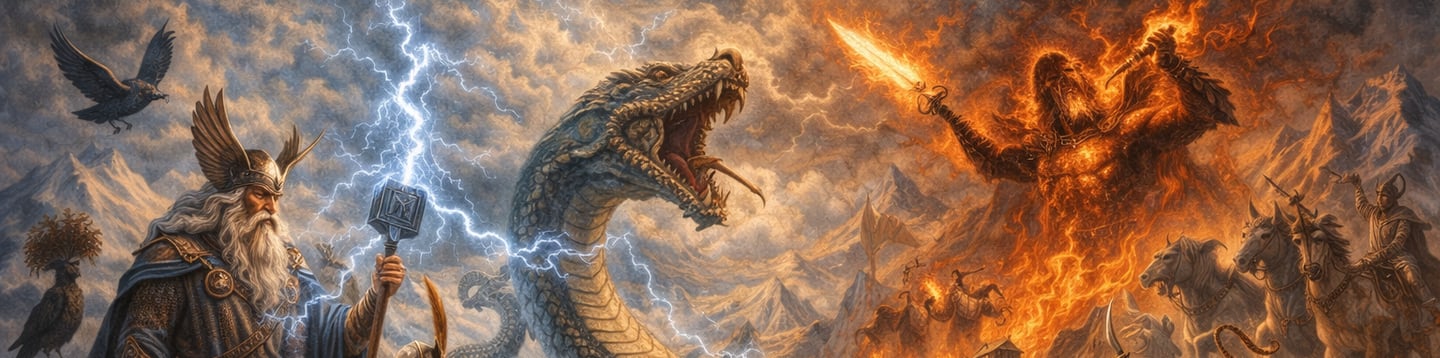
No aspect of Norse mythology has fired the imagination more powerfully than Ragnarök, the doom of the gods, the end of the world, the final battle in which almost everything of value is destroyed. The signs of its approach include the death of Baldr, three years of unrelenting winter, the dissolution of all social bonds, and the breaking of the chains that bind Loki and Fenrir. Then comes the great battle: Fenrir swallows Odin; Thor kills the Midgard Serpent and then dies from its venom; Freyr falls to Surtr's fire, having previously given away his magical sword; Tyr and the great hound Garm kill each other; Loki and the god Heimdall kill each other.
Surtr then sweeps fire across the earth. The world sinks into the ocean. The sun is swallowed.
And then, and this is what makes Norse mythology not simply tragic but something stranger and more interesting than tragedy, the world rises again. The earth comes back from the waters, green and fertile. The surviving gods find the golden game pieces of the old gods in the grass, relics of a vanished age. A man and woman, hidden in the World Tree throughout the destruction, emerge to repopulate the world. A new sun crosses the sky. Even Baldr returns from the realm of the dead.
This resurrection coda has generated enormous debate: is it authentic Norse belief, or a later Christian interpolation? Snorri, as a Christian, might have added it. But the cycle of destruction and renewal is also a pattern deeply embedded in the Norse understanding of time and seasons, and it need not require Christian influence to be plausible. What it adds, in any case, is a profound mythological statement: even in a cosmology built around doom, the last word is not destruction. The world that emerges after Ragnarök is quieter, without the grandeur of the Asgardian age, but it is alive.
The Human Scale: Wyrd, Courage, and the Heroic Ideal
What Norse mythology ultimately teaches, if it can be said to teach anything, is a particular orientation toward existence that the Anglo-Saxons captured in a single word: wyrd, fate, the pattern woven by the Norns that no being can escape. The gods cannot escape it. The greatest heroes cannot escape it. The proper response to wyrd is not despair and not denial but a fierce, clear-eyed courage, the willingness to act well, to fight hard, to maintain one's dignity and one's commitments, knowing that the outcome is not in one's hands.
This is, in a sense, the most modern of the ancient mythological systems. It does not promise divine protection to the righteous. It does not guarantee that virtue will be rewarded in this world or any other. It looks at the full darkness of existence, the grinding cold, the inevitable loss, the serpent gnawing at the roots of the world tree, and asks only: what will you do with the time you have? The Norse warrior, the Norse skald singing of gods and heroes, the Norse farmer watching winter come, all of them understood, at some level, that everything ends. What the mythology gave them was a way of understanding that ending not as defeat, but as the condition within which nobility becomes possible.
That is the gift of Norse mythology to the human imagination: not comfort, but dignity. Not the promise that the cosmos is just, but the conviction that how we face its injustice is entirely our own.
480-366-3550 (Domain Sales)
© SDBEST LLC, 2025. All rights reserved.
Sponsorship Disclosure
Terms of Service