
Egyptian Mythology in the New Kingdom
A Golden Age of Sacred Story
The New Kingdom of Egypt, spanning roughly 1550 to 1070 BCE and encompassing the Eighteenth, Nineteenth, and Twentieth Dynasties, represents one of the most magnificent flourishings of religious imagination in human history. It was an era of empire, wealth, and extraordinary artistic achievement, and all of that energy poured directly into the myths, rituals, and theological systems through which Egyptians understood the cosmos. The gods were not distant abstractions in this period; they were living presences who breathed through temple incense, moved through the waters of the Nile, and walked beside pharaohs on the battlefield. To understand New Kingdom mythology is to enter a world where the sacred and the political, the cosmic and the deeply personal, were woven into a single seamless fabric.
The Cosmic Order and Ma'at
At the heart of all Egyptian mythological thinking, in every period but especially prominent in the New Kingdom, was the concept of Ma'at, a word that translates imperfectly as truth, justice, balance, or cosmic order. Ma'at was simultaneously a goddess, a principle, and a condition of existence. She was depicted as a slender woman wearing a single ostrich feather on her head, and it was that feather against which the heart of the dead was weighed in the Hall of Two Truths. But Ma'at was more than funerary symbolism. She was the reason the sun rose each morning, the reason the Nile flooded at the proper season, the reason pharaoh sat upon his throne rather than chaos devouring the land.
The mythological counterforce to Ma'at was Isfet, disorder, falsehood, entropy. Egyptian mythology in the New Kingdom can be read, in one sense, as the endless cosmic drama between these two principles: order perpetually threatened by dissolution, the gods perpetually laboring to sustain what had been created at the beginning. This drama was not merely theological abstraction. It gave meaning to every ritual, every temple offering, every military campaign. When Thutmose III led his armies into Canaan, he was not simply a king expanding territory, he was pharaoh as cosmic champion, pushing back Isfet at the edges of the world.
The Theban Triad and the Rise of Amun
No single development shaped New Kingdom mythology more profoundly than the ascendancy of Amun. Originally a relatively obscure deity of Thebes associated with hidden, invisible creative force, his very name means "the hidden one", Amun rose to supreme prominence as the Theban rulers of the Eighteenth Dynasty expelled the Hyksos and reunified Egypt. Victory in war was attributed to his patronage, and the gratitude of pharaohs translated into staggering temple complexes, priestly wealth, and theological elaboration.
Through a process the Egyptians called syncretism, the merging of divine identities, Amun absorbed the solar power of Ra to become Amun-Ra, simultaneously the hidden creative breath and the blazing eye of the sky. This fusion made him effectively the king of the gods, the self-created, self-sustaining source of all existence. The great temple complex at Karnak, built and expanded over centuries but reaching its most magnificent expression in the New Kingdom, was the earthly house of this cosmic lord. Walking the hypostyle hall at Karnak, its 134 massive columns inscribed from floor to ceiling with sacred texts and divine imagery, was to enter the body of mythology made stone.
Amun was worshipped alongside his consort Mut, a mother goddess whose name simply meant "mother," and their son Khonsu, the moon god. Together they formed the Theban Triad, a divine family unit whose mythology centered on themes of creation, protection, and the cyclical renewal of time. Khonsu was associated with healing and with the measurement of time by the moon's phases, and his cult was particularly beloved in the later New Kingdom.
Osiris, Isis, and the Eternal Drama of Death and Resurrection
If Amun-Ra dominated the theology of state and kingship, the myth cycle of Osiris, Isis, Set, and Horus dominated the Egyptian imagination of death, resurrection, and moral justice. This story, arguably the most elaborately developed myth in all of Egyptian religion, reached something like its fullest literary expression during the New Kingdom, and it colored every aspect of funerary practice, royal ideology, and personal piety.
The essential outline of the myth is ancient: Osiris, the good king of Egypt, was murdered by his jealous brother Set, who dismembered the body and scattered the pieces across the land. His devoted sister-wife Isis gathered the fragments, reassembled them, and through her supreme magical power conceived a son, Horus, with the reconstituted body. Osiris was resurrected, not to life in the world of the living, but to eternal sovereignty over the world of the dead. Horus, having grown to manhood, contested Set for the throne of Egypt and ultimately prevailed, establishing the divine lineage that every pharaoh was understood to embody.
In the New Kingdom, this myth became extraordinarily rich in its theological implications. Osiris became the universal promise of resurrection, not only for pharaohs, as in earlier periods, but for every Egyptian who lived justly and honored the gods. The Book of the Dead, that magnificent New Kingdom compilation of spells, hymns, and ritual instructions, was essentially a mythological guidebook for the soul's journey through the underworld, navigating past serpents and gates and demons toward the Hall of Two Truths where Osiris sat enthroned and the heart was weighed.
Isis herself grew into one of the most theologically complex and emotionally resonant figures in all of Egyptian religion. She was the devoted wife, the grieving mother, the supreme magician who could outwit even Ra himself, a story preserved from this period in which she tricked the sun god into revealing his secret name, gaining power over him. She was mourner, healer, protectress, and cosmic weaver. Her cult in the New Kingdom was deeply personal in a way that Amun-Ra's state theology was not. Ordinary Egyptians prayed to Isis for healing, for protection in childbirth, for comfort in grief. She wept, and Egypt understood her tears.
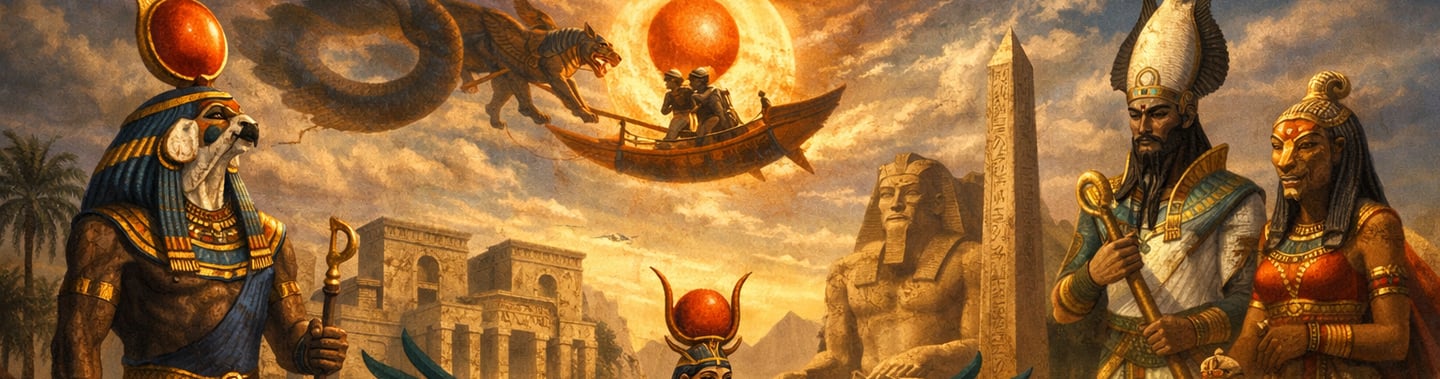
Set, meanwhile, occupied a fascinating and morally ambiguous position in New Kingdom mythology. He was the murderer of Osiris, the eternal adversary of Horus, and yet he was also the great warrior who stood at the prow of Ra's solar barque each night, fighting off the serpent Apophis as Ra made his dangerous journey through the underworld. Set was not purely evil. He was chaos, which could destroy or protect depending on whether it was properly directed. Several New Kingdom pharaohs, particularly in the Nineteenth Dynasty, Seti I and Ramesses II among them, actually bore Set's name with pride and associated themselves with his ferocious power.
The Solar Journey and the Underworld
One of the great mythological achievements of the New Kingdom was the elaboration of what might be called the solar cosmology, the detailed mythological account of the sun god's journey through the twelve hours of the night. Ra, traveling in his barque, descended each evening into the Duat, the Egyptian underworld, and passed through successive realms populated by gods, souls, demons, and guardians. At the nadir of his journey, in the deepest hour of the night, he merged briefly with Osiris, solar fire and chthonic resurrection united for a single transformative moment, before being reborn at dawn as Khepri, the scarab beetle rolling the sun disk over the horizon.
This cosmology was encoded in magnificent royal tomb texts: the Amduat ("That Which is in the Underworld"), the Book of Gates, the Book of Caverns, all of which were painted or inscribed in the royal tombs of the Valley of the Kings. These were not merely decorative programs. They were mythological technologies, intended to ensure that the dead pharaoh could participate in Ra's journey and rise again with him. The Valley of the Kings is, in this sense, a library of cosmological mythology carved into the living rock beneath the Western horizon, where the sun was understood to descend.
The Amarna Interlude and the Return of the Gods
No account of New Kingdom mythology can pass over the extraordinary interruption of the Amarna Period, when the pharaoh Amenhotep IV, who renamed himself Akhenaten, "Effective for the Aten", dismantled the traditional polytheistic system and promoted the worship of the Aten, the sun disk itself, as the sole divine power. The temples of Amun were closed, their priesthoods disbanded, their revenues seized. The divine names were chiseled from monuments in an act of unprecedented theological violence. Akhenaten composed the famous Great Hymn to the Aten, a poem of genuine beauty that celebrated the sun's light as the one source of all life and being.
What makes this episode mythologically significant is less Akhenaten's theology itself than the ferocity of the reaction that followed his death. Under Tutankhamun and especially under Horemheb and the subsequent Ramessid pharaohs, the traditional mythology was restored with passionate intensity. Akhenaten's monuments were dismantled. His name was systematically erased. The old gods returned, and they returned, one senses, with a heightened emotional urgency. The mythology of Amun-Ra, of Osiris and Isis, of the solar journey through the underworld, was re-inscribed on Egypt's temples and tombs with renewed vigor, as if the culture understood that it had looked into the abyss of a world without story and pulled itself back.
Personal Piety and the Living Mythology
Perhaps the most moving aspect of New Kingdom mythology is the evidence of genuine personal religious feeling that survives from this period. Beyond the grand theological systems and the state rituals, ordinary Egyptians prayed, made vows, composed hymns, and experienced the gods as intimate presences in their daily lives. The goddess Hathor, the beautiful, joy-loving deity of love, music, and fertility, was enormously popular in this period, her face appearing on mirrors, sistrums, and household shrines. Bes, a fierce dwarf god who protected households and women in childbirth, peered out from amulets and painted walls.
The mythology of the New Kingdom was, ultimately, a living thing. It was not doctrine fixed in text but a constantly evolving conversation between the human and the divine, expressed in ritual, in image, in story, and in the quiet prayers whispered before small household shrines by people whose names we will never know. They understood themselves to be embedded in a cosmic drama whose resolution had been settled at the foundation of the world, Ma'at would prevail over Isfet, the sun would rise, Osiris would be vindicated, and the just heart would pass through the fire and find its rest. That story, told ten thousand ways across five centuries of New Kingdom glory, remains one of humanity's most extraordinary mythological inheritances.
480-366-3550 (Domain Sales)
© SDBEST LLC, 2025. All rights reserved.
Sponsorship Disclosure
Terms of Service